Dream-Cubedとは
Dream-Cubed とは、Minecraft のワールドをブロック単位で生成するための大規模データセットと生成モデル群です。Sakana AI がニューヨーク大学と共同で開発し、2026年7月29日に公開しました。論文の正式な題は「Dream-Cubed: Controllable Generative Modeling in Minecraft by Training on Billions of Cubes」で、データ・モデル・コードのいずれも公開されています。
公開されているのは次の3点です。技術ブログが pub.sakana.ai/dream-cubed、論文が arXiv(2604.22847)、コードが GitHub の SakanaAI/DreamCubed です。
We are excited to share our latest work, together with New York University: Dream-Cubed: Controllable Generative Modeling in Minecraft by Training on Billions of Cubes. / Technical Blog: https://pub.sakana.ai/dream-cubed / Paper: https://arxiv.org/abs/2604.22847 / Code: https://github.com/SakanaAI/DreamCubed — ニューヨーク大学との共同研究であること、論文の正式題、および公開物の所在に関する記述より
なぜMinecraftなのか
題材の選び方に、この研究の考え方が表れています。生成AIは画像・動画・文章では大きく進みましたが、ビデオゲームの対話的な3D世界はほとんど手つかずでした。Sakana AI はその隙間を埋めることを狙っています。
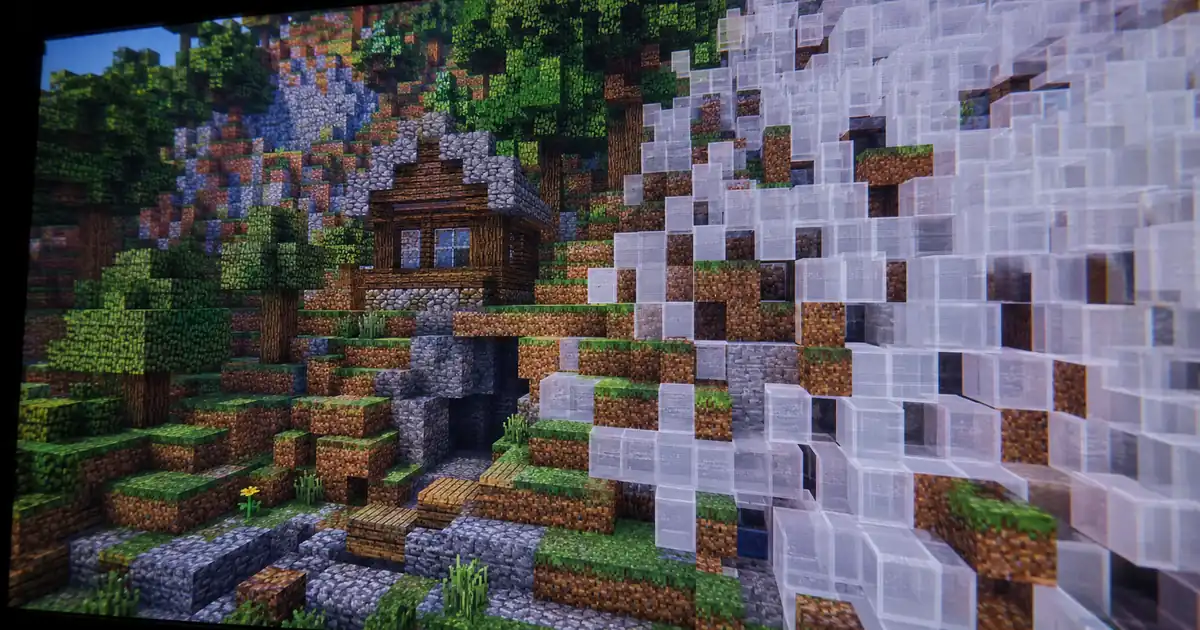
Minecraft を選んだ理由は、世界の作られ方にあります。Minecraft の3D世界はボクセル、つまり砂・石・水といった意味を持つ離散的なブロックの積み重ねでできています。この構造が生成モデルにとって都合がよい、というのが着眼点です。
文章が単語という単位に分かれていて、そのおかげで言語モデルの学習が成り立ったのと同じように、Minecraft の世界はブロックという単位に分かれています。ゲーム世界のひとかたまりは、ブロックというトークンの集まりでしかない。この対応があるから、言語モデルで使われる大規模な Transformer をそのまま持ち込める、という発想です。
Generative AI has made incredible progress in the fields of image, video, and text generation. Despite success in these modalities, the interactive 3D worlds of video games have received much less research attention. / The 3D world of Minecraft is made up of voxels: discrete, compositional building blocks like sand, stone, and water. These semantically meaningful block types provide a perfect abstraction for generative modeling: each piece of the game world is simply a collection of block tokens that come together to create a simulacrum of the natural world. — 3D世界が研究上の空白であること、およびボクセル構造が生成モデルに適する理由に関する記述より
300億ブロックのデータセット
集められたデータの内訳も公開されています。ひとつは Minecraft の手続き生成、つまりゲームが自動的に作り出す地形から集めたもので、32×32×32のかたまりを180万件以上。もうひとつが人間の制作者が手で作ったマップから集めたもので、こちらは20万件規模です(原文の表記は 200,00+ で桁が省かれています)。合わせて300億個を超えるブロックになります。
Dream-Cubed データセットの構成(公式発表による)
200,00+ で桁が省かれている/制作者の許諾を取得)手続き生成のデータは事実上いくらでも取れますが、そのまま集めると偏ります。村はゲーム世界で最も構造が複雑でありながら、最も出現頻度が低いからです。そこで狙って特定のバイオームを集める仕組みを用意し、必要な量を確保しています。この配分が下流のモデルに大きく効くことも、後述する実験で示されています。
人間のデータのほうは希少です。Planet Minecraft のような共有サイトがあり、手作りのマップを販売して収入を得ている職業的な制作者もいます。研究チームはそうした制作者のひとりに連絡を取り、大規模で高品質なマップを使う許可を得ました。公開にあたっても制作者との合意のうえで行っていると明記されています。
We create automated data collection and curation pipelines, collecting 1.8+ million 32³ chunks of procedurally generated Minecraft worlds, and 200,00+ chunks from human-authored maps, comprising over 30 billion total blocks. / We collect chunks from the surface level of the world and assign a class label based on the biome they are in, creating a dataset for biome-conditional generation. / Villages, for example, are both the most structurally complex and the least common areas of the game world. To overcome this data balancing problem, we set up targeted collection pipelines to identify and collect specific biomes to ensure adequate representation, which we show can have a very significant impact on downstream models. / Biome-conditioned 32³ chunks generated by our top-performing discrete MD4 model and continuous DDPM model for each of the 15 biome classes. / We reached out to one such professional map creator, who granted permission to use several of their large and high-quality maps for scraping. We release all our data and models in accordance with the map creators for the larger research and Minecraft community. — データセットの規模、バイオームによる分類とその種類数、偏りへの対処、および人間制作マップの許諾に関する記述より
効率を捨てて「細かい制御」を取った設計
技術的にいちばん重い判断が、ここに置かれています。理解しておくと、この研究が何を優先したのかが見えてきます。
圧縮せずに元の解像度で学習した
画像生成などで使われる拡散モデルは、ふつう変分オートエンコーダ(VAE)のようなモデルで圧縮した表現の上で動きます。データを小さくしてから扱うことで、計算効率が大幅に上がるためです。
Dream-Cubed はこれをやりません。空間の次元を圧縮しないという設計判断を明示的に採っています。32×32×32のかたまりをそのまま3D拡散 Transformer へ流し込む方式で、モデルの規模は約2億8千万パラメータです。
効率上の利点は捨てることになります。それでも公式は、この選択が生成に対する細かい制御を可能にするために決定的だったと述べています。速さより操作性を取った、という設計です。
A key design decision is not to compress the spatial dimensions of our data. Commonly, diffusion models operate on the compressed representations from models like Variational Autoencoders, which can massively improve the efficiency of diffusion models. We choose to train directly at the native block resolution, feeding each 32³ chunk of the world into a 3D Diffusion Transformer with ~280M parameters. While we miss out on the performance gains of compressed representations, we find this choice is crucial for enabling fine-grained control over generation. — 空間次元を圧縮しないという設計判断と、その代償および狙いに関する記述より
2つの拡散方式を比べた
Minecraft のブロックは、数千種類の語彙から選ばれるカテゴリ的な値です。連続的な数値ではありません。ではどんな生成モデルが向いているのか。研究チームは同じ Diffusion Transformer の骨格を使って、2つの方式を比較しています。
ひとつは MD4 という離散マスク拡散です。語彙に [MASK] という特別な状態を追加し、本物のブロックを少しずつ [MASK] へ置き換えて壊します。生成時はその逆をたどり、[MASK] の位置に元のブロック種別を予測して埋め戻していきます。
もうひとつは 埋め込み空間での DDPM です。各ブロック種別を、ゲーム内での名前(たとえば "stone")を使って凍結済みのテキスト埋め込みモデルに通し、16次元のベクトルへ写します。そこへ少しずつガウスノイズを加えて壊し、ノイズを取り除いて復元したあと、最も近いベクトルを探して離散的なブロック種別に戻します。
どちらも学習課題そのものはうまくこなしました。指定したバイオームに合った、それらしいかたまりを生成できています。ただしこれだけでは優劣が決まりません。決め手になったのは次の性質です。
We implement two diffusion formulations: / MD4 discrete masked diffusion: We add a special [MASK] state to the vocabulary, and corrupt chunks by gradually replacing real blocks with [MASK] tokens. To generate new chunks, the model "unmasks" blocks by predicting the original block type to replace the [MASK] tokens. / DDPM in embedding space: We map each block type to a 16-dimensional vector obtained by a frozen text embedding model, using the block's in-game name (e.g., "stone"). Chunks are corrupted by gradually adding Gaussian noise, and we generate chunks by gradually removing noise back to clean embeddings. We perform a nearest neighbor lookup to recover discrete block types from denoised embedding vectors. / With our carefully curated data and after hyper-parameter tuning, we show that both models perform well on the training task, generating believable 32³ conditioned on a target biome, as seen below. — 比較した2つの拡散方式の手順と、どちらも学習課題をこなせたという結果に関する記述より
「部分埋め」「拡張」がタダで付いてくる
離散マスク拡散を選んだ理由は、学習目的の副産物として対話的な生成の手順が手に入ることでした。
仕組みは単純です。生成の過程では [MASK] を1つずつ埋めていき、埋めた結果が残りの生成の条件になります。この性質があるので、最初の状態として好きなブロックの並びを書き込んでおけば、それがモデルの守るべき制約になります。生成の途中で書き込むこともできます。
圧縮していないため、これは「Minecraft のブロックを数個、望む形に置く」だけの作業になります。ゲーム世界から取ってきたかたまりの一部を作り直させることも、自分で模様を手作りして残りを埋めさせることもできます。実演では、Minecraft には自然に存在しない火山のような形を暗示する並びを与えても、うまく外挿して成立させています。
さらにこの性質を使えば、32×32×32という枠にも縛られません。重なりを持たせながら生成の窓をずらしていくという単純な手順で、いくらでも大きなワールドを作れます。
This simple property gives us a fine-grained block-conditioning on top of class-conditioning as a free byproduct of training. / In practice, this means we can write any pattern of blocks as an initial state and even during the generation process, which becomes a hard constraint that the model must work around. Because we work at the native resolution using the in-game block vocabulary, this translates to simply placing a handful of Minecraft blocks in a desired pattern. / We can use a simple sliding window procedure to generate arbitrarily-sized worlds, generating overlapping chunks in sequence and stitching them together: — ブロック指定生成が学習の副産物として得られること、および任意サイズのワールド生成に関する記述より
評価で分かったこと
評価の部分にも読みどころがあります。3D のボクセル世界には確立された評価指標が無いため、研究チームは指標そのものの妥当性から検証しています。
データの配分が結果を左右した
まず、データの中身をどう配分するかがどれだけ効くのかを確かめる実験です。それぞれ100万件のかたまりからなる3つの変種を用意しています。
データセット3変種の比較(公式発表による)
| 変種 | 中身 | 結果 |
|---|---|---|
| Balanced | 15のバイオームを均等に配分 | 基準となる配分 |
| Boosted | 村のサンプルを2倍に増やす | 村のFIDが大きく改善 |
| Natural | ゲーム内の自然な出現率のまま集める | 海(35%)は良い成績、村(1%未満)で成績が落ちる |
素朴に集めた Natural は、データの35%を占める海のバイオームでは良い成績を出す一方、1%にも満たない村では成績が落ちました。村のサンプルを倍に増やした Boosted では、FID が大きく改善しています。何を多く見せたかが、そのまま何を上手に作れるかになる、という当たり前の関係が数字で確認された形です。
あわせて、DiT のパッチサイズ2と4も比較しています。パッチ4のモデルは村のバイオームで大きく性能が落ちており、複雑なデータを扱うには細かい解像度が重要であることが示唆されています。
To test how important data composition is, we create three variants of our dataset, each with 1 million chunks. The Balanced dataset represents even distribution between the 15 natural biome classes, while the Boosted dataset doubles the proportion of village samples. The Natural dataset represents the naive approach, collecting chunks at their natural spawn rate in the game world, leading to large imbalances between biome labels. / We can see a significant performance drop in our patch 4 models in the village biome, suggesting that the finer resolution at lower patch sizes is important for modeling this more complex data. Similarly, we see differences regarding dataset composition: the Natural dataset model performs well on the overrepresented ocean biome (35% of the dataset), and underperforms in the village biome (< 1% of the dataset). We find that doubling the number of village samples compared to the rest in the Boosted model, we see a significant improvement in FID. — データセット3変種の中身、パッチサイズの影響、およびデータセット構成による成績の違いに関する記述より
プレイヤーは生成物のほうを選んだ
もっとも目を引く結果がこれです。数値上それらしく見えるとして、では本物の Minecraft の世界とどれだけ似ているのか。研究チームはこの3Dボクセル世界の専門家、つまり Minecraft のプレイヤーに判定を委ねました。
実験は単純です。同じバイオームについて2組のかたまりを見せ、良いと思うほうを選んでもらいます。比較対象には離散モデル2つ、DDPM モデル1つ、そして学習データから取った本物のサンプルが含まれています。
結果は、3つのモデルすべてで、生成されたかたまりのほうが本物より好まれました。ただし勝率には幅があります。MD4(パッチ2)が67.1%(173試行)、MD4(パッチ4)が57.1%(163試行)、DDPM(パッチ2)が55.2%(192試行)で、3つのうち2つは互角に近い水準です。
公式も、この結果を額面どおりには扱っていません。データの選別と生成の過程による部分もあるかもしれないと断ったうえで、少なくとも模倣しようとしている分布と同等の水準にはあることの証拠と見ている、という慎重な書き方をしています。「AIが人間を超えた」という話ではなく、「狙った分布を再現できている」という主張です。
We create an experiment where humans view two sets of chunks for the same biome, and pick the one they think is better. We include samples generated by two of our discrete models, our DDPM model, and real samples taken from our training data. / MD4 (patch 2) Real 67.1% 173 / MD4 (patch 4) Real 57.1% 163 / DDPM (patch 2) Real 55.2% 192 / Model vs. real. Win rate is the fraction of trials where participants preferred generated chunks from Source A over real Minecraft chunks from the same biome. / Across all three models, generated chunks were actually preferred to real ones. This may be partly due to our process of data curation and generation, but we view it as evidence that generated chunks are at least on par with the distribution we're trying to model. — 人間による比較実験の設計、モデル別の勝率と試行数、およびその結果に対する解釈に関する記述より
指標の妥当性まで検証している
もうひとつ丁寧なのが、使った評価指標そのものを検証している点です。3Dのボクセル世界には確立された指標が無いため、画像生成で使われる FID(Fréchet Inception Distance) をレンダリング画像に対して適用しています。
ただし、それが本当に3Dのかたまりの品質を測れているのかは自明ではありません。そこで人間の選好データを使い、FID が低いモデルのほうがより多く選ばれるかを確かめています。結果は、限定的ではあるが有意な関係が見られた、というものでした。モデル間の FID の差が小さいバイオームでは関係が弱く、差が大きい構造的なバイオームでは指標と選好がよく一致しています。
Lacking established metrics for 3D voxel worlds, we adapt Fréchet Inception Distance (FID) [4] to measure the differences between our models. / Using this data, we validate the render-based FID metric we use. If image-based FID is a good proxy for 3D chunk quality, we'd expect that lower-FID models would win more against higher FID models. / And we do find a limited but significant relationship between FID and win rate. In particular, we find that for biomes where there are small FID differences across models, this relationship is weaker. However, focusing on more structured biomes where the FID differences are larger, alignment of our metric with human judgment becomes stronger, with the lower-FID model winning 66.1% of the time when the gap is > 15 points. — 3Dボクセル世界に確立した指標が無いこと、FIDをレンダリング画像へ適用したこと、および人間の選好で指標そのものを検証した結果に関する記述より
人間が作ったマップは語彙を絞って学習した
人間が作ったマップで学習する場合には、数千種類あるブロックを171種類まで圧縮しています。制作者は細かい見た目を出すためにより多くの種類のブロックを使いますが、語彙を絞ることでデータが単純になり、モデルが人間の複雑な構造物のほうに集中できるためです。あわせて、人間の創造性を含むデータから生成を学ぶことには新しい課題と倫理的な論点が伴うことを認め、この成果はその領域における第一歩だとしています。
When training on human-authored maps, we treat each map as its own additional "biome", and compress the thousands of block types present in this data down to a smaller, more manageable vocabulary of 171 unique blocks. As map creators use a much larger palette of blocks to capture small visual details, compressing maps to a limited vocabulary results in data that is simpler, allowing our models to focus instead on capturing the complex and detailed human structures. We acknowledge that learning to generate from data that encodes human creativity comes with a new set of challenges and even ethical considerations, and we present our models and results as a first step in this domain. — 人間制作マップの語彙を171種類へ圧縮した理由と、その扱いに伴う倫理的な論点に関する記述より
Sakana AIの研究の流れの中で見る
Dream-Cubed は単発の話題作ではなく、同社が続けてきた方向の延長にあります。
「既存の枠組みを別の対象へ持ち込む」やり方
言語モデルで確立された手法を、ブロックという別の単位へそのまま持ち込む。この構図は、同社の他の研究とも重なります。進化的な探索を扱ったPicbreeder の研究や、AIエージェントの実務能力を測るCoffeeBenchも、既存の道具立てを別の問いへ当て直すという性格を持っています。
コーディングエージェント Fugu のように製品化された成果もあれば、今回のようにデータセットとコードを公開して研究コミュニティへ渡す形もあります。インフラ面ではNVIDIA との提携も伝えられています。
「遊べる」ことの意味
この研究で繰り返し強調されているのは、生成物がそのまま編集できて遊べるという点です。眺めるための3Dモデルではありません。
ゲーム内のブロック語彙をそのまま扱い、圧縮せずに元の解像度で生成しているからこそ、出力がそのままゲームの内容物になります。効率を捨てた設計判断が、ここで回収されています。プレイヤーや制作者が数個のブロックを置くだけで残りをモデルに埋めさせられる、という操作感は、この積み重ねの結果です。
We use our data to train a family of powerful transformers for efficient generation of interactive 3D environments at cube resolution. We show how our models allow players to mold the world around them by generating structures, terrain, and maps that are immediately editable and playable. — 生成物がそのまま編集・プレイ可能である点に関する記述より
まとめ:注目点は「生成物が遊べる形で出てくる」こと
Dream-Cubed でいちばん報じられやすいのは、プレイヤーが生成物を本物より好んだという結果でしょう。ただしこれは公式自身が「データの選別と生成の過程による部分もあるかもしれない」と断っている数字で、そのまま「AIが人間を超えた」と読むのは行き過ぎです。
技術的に効いているのは、むしろ地味な設計判断のほうです。圧縮しないと決めたこと。そのおかげで生成の途中に好きなブロックの並びを差し込めるようになり、部分埋めも、任意サイズへの拡張も、学習目的の副産物として手に入りました。効率と操作性のどちらを取るかという選択で、後者を取った結果が全体を貫いています。
もうひとつ押さえておきたいのは、データの配分が成績を左右したという実験結果です。自然な出現率のまま集めれば、珍しくて複雑なものほど作れなくなる。これは Minecraft に限った話ではなく、データを集めて学習させるあらゆる場面に当てはまります。
データ・モデル・コードがすべて公開されているため、追試も応用も可能です。ゲーム開発に関心があるかどうかにかかわらず、離散的な単位を持つ対象なら同じ手が使えるかもしれないという点で、目を通しておく価値のある研究になっています。詳細を追う場合は技術ブログを読みやすい形に変換して手元に残しておくと比較が楽です。