What the data centers paid for
The visible result is municipal infrastructure that a town of this size does not normally get. It started with one land purchase.
Twenty years, one town
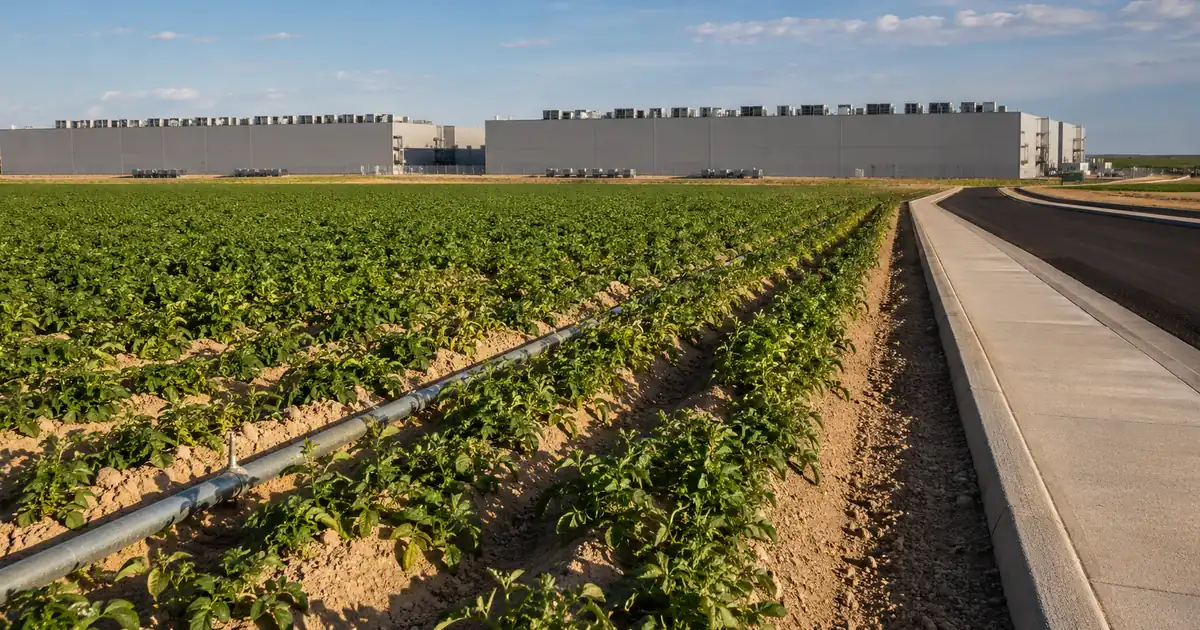
"In 2006, Microsoft bought 75 acres of bean fields in an industrial zone in Quincy to build a 500,000-square-foot company-owned data center for its Bing search engine and Hotmail email servers." — CNN Business
The tax base did the work
A $120 million high school is not something 8,500 people fund out of household property tax. The facilities carry an estimated 57% of the town's property taxes, and the building program followed from that arithmetic.
This is the part of the story that transfers least well. It depends on a tax structure that treats data centers as local property, and on a town small enough that thirty of them dominate the roll.
"Just about all the infrastructure and services are new and improved in this rural central Washington farming town of 8,500, miles from the Columbia River. There's a $120 million state-of-the-art high school. Hospital. Public library. Police and fire stations. Paved sidewalks, sewage systems and wastewater treatment plant. It's been made possible by data centers."(the town)/"Roughly 30 data centers shoulder an estimated 57% of Quincy's property taxes, funding the city's public building spree."(the tax base) — CNN Business
The poverty rate fell by more than twenty points
From 29.4% in 2012 to 6.2% in 2024 is not a rounding of the same population's fortunes. Around 900 jobs went to engineers, pipefitters and electricians, and Washington State analyses put four to six further jobs behind each of those.
The pace matters as much as the total. Patrick Boss of the Port of Quincy describes twenty years of organic growth rather than a boom, which is the difference between a town absorbing an industry and being flooded by one.
"They created around 900 jobs for engineers, pipefitters and electricians in the town. Each of those also generates four to six other jobs in construction, retail and local services, according to Washington State analyses."(jobs)/"New businesses, nonprofits and neighborhoods have popped up to cater to people moving to town, and the poverty rate has fallen from 29.4% in 2012 to 6.2% in 2024."(poverty rate)/""It's been controlled organically over 20 years," said Patrick Boss from the Port of Quincy, an economic development agency."(pace) — CNN Business
What residents pay
The objections CNN records elsewhere are higher electricity bills, pollution and AI taking jobs. Quincy has numbers for the first, and for water — the resource a farming town watches hardest — and neither lands the way the argument usually assumes.
Who carries the load
Rates rose faster for the data centers than for households
Both went up. The gap is the point: 3.5% against 9.1%. The generation and infrastructure that big loads require gets billed to the users creating them.
That does not make the concern imaginary elsewhere. It shows that whether households absorb the cost is a question of rate design, and Grant County's answer is not the only one available.
"The public believes that data centers drive up the cost of electricity. Electricity bills have gone up in Quincy, but large industrial customers like data centers are shouldering the burden. Residential power rates went up 3.5% last year in Grant County, home to Quincy, while large industrial customers' rates went up 9.1%."(electricity)/"Data centers and other large users pay for the infrastructure and generation needed to serve their large power loads — costs are not spread to residential customers."(who pays) — CNN Business
Water goes mostly to food processing
Around 8% of the city's supply goes to the data centers. More than half goes to food processors, which is what a farming town's water use looks like with or without a server hall.
The reuse facility is the more interesting detail. Microsoft partnered with the city to build a $30 million plant that processes cooling water for the data centers and other industries, so the treatment capacity sits with the town rather than behind a fence.
"Data centers also only use around 8% of the city's water supply, officials say. Microsoft partnered with the city to build a $30 million water reuse facility to process cooling water for data centers and other industries. More than 50% of water in Quincy goes to food processors." — CNN Business
Who did not get in
A falling poverty rate can describe a population that got richer or one that got replaced. In Quincy the honest answer involves both.
The gap
Housing outran incomes
Doubling in a decade prices out anyone whose wages did not follow, and the housing that got built was single-family. Apartments and rentals — the stock a farmworker household can actually reach — did not get built.
The town has since changed its zoning code to make low- and middle-income rentals easier to build. That is a response to a problem already twenty years in, not a plan that ran alongside the growth.
"Home prices have roughly doubled over the last decade, rising faster than incomes, as more people move to Quincy. New single-family neighborhoods have been going up, but the town lacks apartment buildings and rentals. Quincy recently approved a zoning code change to making it easier to build rentals for low and middle-income households." — CNN Business
The jobs went to people who moved in
Quincy's Hispanic population went from 37% in 1990 to around 75%, and a large migrant farmworker population works there for part of the year. Nina Martinez, executive director of the Latino Civic Alliance in Washington, told CNN that much of the data center workforce came from other places.
A town can be transformed without its existing residents being the ones transformed. Both are true at once, and any town reading Quincy as a template needs the exclusion in the plan, not in the postmortem.
"Many of these agricultural workers have missed out on the data center economy, said Nina Martinez, the executive director of the Latino Civic Alliance in Washington. "A lot of the workforce is coming from other places," she said."(who got the jobs)/"Quincy's Hispanic population increased from 37% in 1990 to around 75%, and a large migrant farmworker population also works there part of the year."(population) — CNN Business
For the rate-design question this raises at national scale, see US Ratepayer Protection Act. For the same buildout viewed as industrial policy, see China's $295B AI five-year plan.
Long feature reporting is easier to check against a source when it is plain text.