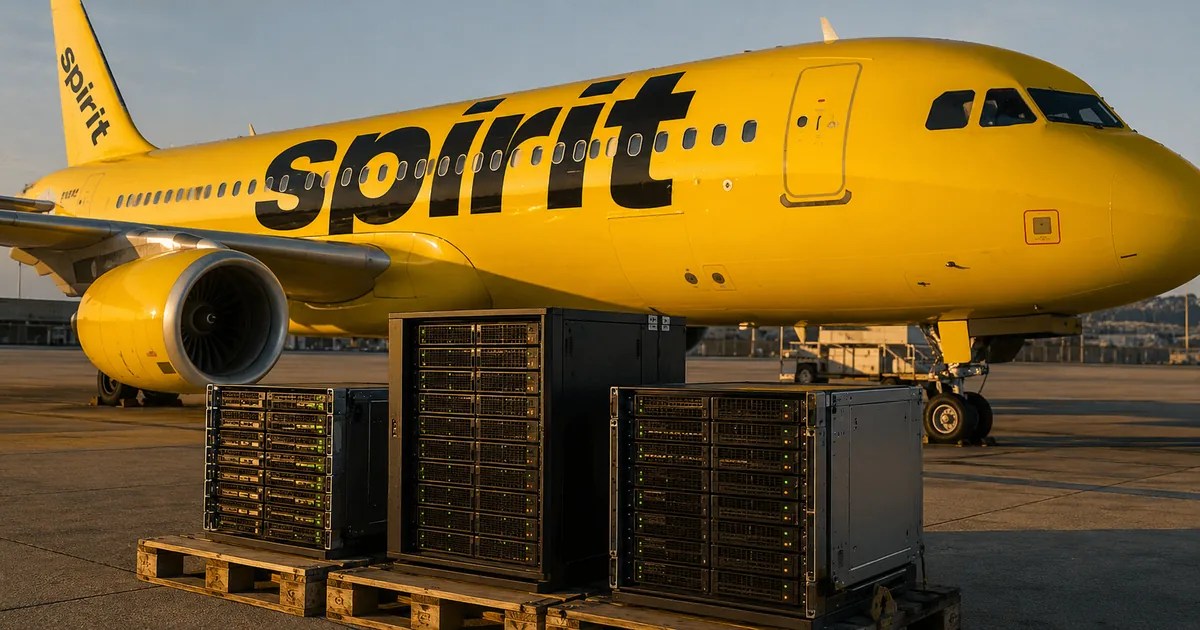
How the Google Spirit Airlines data auction went
Spirit Airlines stopped flying earlier this year after failing to emerge from its second Chapter 11 bankruptcy, and its attorneys are still working through what is left.
"Spirit Airlines ceased operations earlier this year after it failed to emerge from its second Chapter 11 bankruptcy, but attorneys are still handling the disposition of its assets."— from Axios
Google bid $10 million for the business data
What went to auction was not aircraft or gates. It was the operational data still sitting in the company's systems, and Google won it with a $10 million bid. The package is emails, calendar information, chats, documents, and spreadsheets — the residue a business accumulates simply by running. A Google spokesperson said the company acquired part of an enterprise dataset from Spirit Airlines, which can be helpful in improving its products and AI models.
"Google is acquiring Spirit Airlines' emails, calendar info, chats, documents, spreadsheets and other business data, according to a bankruptcy court filing." (what is being acquired)/"Google won a bankruptcy auction for the data, agreeing to pay $10 million for the information." (the price)/"We acquired part of an enterprise dataset from Spirit Airlines, which can be helpful in improving our products and AI models," (Google spokesperson)— from Axios
The runner-up was AI hiring platform Mercor
The competition did not come from aviation. The next-highest bidder was Mercor, an AI-powered hiring platform, at $7.5 million. Two AI companies bidding against each other for an airline's internal correspondence says more about what the asset is than any description of it would.
"If it doesn't go through, AI-powered hiring platform Mercor was the next-highest bidder, at $7.5 million."— from Axios
What is actually in the data being sold
The itemized contents describe the asset better than the price does.
100 million emails and 500 million Teams chats
The court filing puts roughly 100 million emails and 500 million Microsoft Teams chats in the deal. Natural workplace conversation between real people, at that volume and in one coherent corpus, is not something that comes up for sale often. Marketing materials, HR information, project management documents, financial databases, audits, and presentations are bundled in alongside it.
"The deal includes about 100 million emails and 500 million Microsoft Teams chats, according to a court filing." (message volume)/"In addition to interpersonal communications, the data includes marketing materials, HR info, project management documents, financial databases, audits and presentations." (other categories)— from Axios
Pricing data, code, and employee records are included
Bloomberg Law, working from the August 14 court notice directly, lists a wider inventory. About 30 million lines of code and development metadata, software models and algorithms, pricing from 7.2 billion competitor flights, and an estimated 7.5 billion passenger transaction records going back to 2008. The notice also names revenue, aircraft operations, employee productivity, audits and fraud, and — on the business side — marketing campaigns, human resources, strategy, and project management, and puts employee records at more than 175,000 dating to 1986. The volume runs well past what one airline's paperwork sounds like it should.
"The tech giant’s $10 million bid includes a vast repository of the defunct airline’s data, including 100 million emails, 500 million Microsoft Teams chats and collaboration records, plus information related to revenue, aircraft operations, employee productivity, and audits and fraud, according to an Aug. 14 notice in the US Bankruptcy Court for the Southern District of New York." (top-level contents)/"Also included is pricing from 7.2 billion competitor flights, an estimated 7.5 billion passenger transaction records going back to 2008, and pricing curve data, according to court records." (pricing and transaction data)/"Google’s purchase also includes about 30 million lines of code, development metadata, and software models and algorithms. The purchase also includes more than 175,000 employee records dating back to 1986." (code and employee records)/"The cache includes data related to marketing campaigns, human resources, strategy, and project management." (business functions)— from Bloomberg Law
Passenger profiles and frequent flyer data are excluded
The exclusions are stated as plainly as the inclusions. Passenger profiles and frequent flyer information are not part of the sale. Bloomberg Law puts numbers on what that leaves out: 97.5 million passenger profiles and an estimated 50.2 million records tied to the Free Spirit loyalty program, along with privileged materials. What changed hands is the company's own operational record rather than a customer ledger, which is the distinction the filing draws.
"It does not include passenger profiles or their frequent flyer information."— from Axios
"Google’s purchase doesn’t include personal data and privileged materials like Spirit’s 97.5 million passenger profiles or an estimated 50.2 million records related to the Free Spirit loyalty program data, according to court records."— from Bloomberg Law
How personal information is handled, and who signs off
When a bankrupt company's data is sold, the question that matters most is what happens to the people inside it.
A third party strips identifying information first
A court filing from Spirit's investment banker states the data contains no personally identifiable information. It is to be deidentified — not associated with individual people — and the buyer agrees not to attempt re-identification. Google says any data it receives will be rigorously scrubbed of personally identifiable information by a third party before receipt. How far that scrubbing reaches is harder to judge from a statement alone, given how much of a workplace email or chat consists of naming people and describing their situations.
"The data does not contain any personally identifiable information, according to a court filing by PJT Partners vice president Dylan Friesner, an investment banker for Spirit." (the filing)/"The data will be \"deidentified\" — meaning that it won't be associated with individual people and the buyer agrees not to attempt to re-identify the users." (deidentification terms)/"We will not receive any personal information from this dataset. Any data we receive will be rigorously scrubbed of any personally identifiable information by a third party before receipt." (Google statement)— from Axios
The sale hearing is set for August 19
Nothing is final yet, because a federal judge has to approve the deal. The sale hearing is scheduled for August 19, 2026 before Judge Sean Lane in the US Bankruptcy Court for the Southern District of New York. Running the sale through bankruptcy is what puts a court between the data and the buyer at all. Even when training data is acquired through entirely legitimate channels, where the line falls between a saleable asset and something else gets drawn case by case in proceedings like this one. A different route to the same shortage runs through Amazon cutting up rare books to scan them, and the disclosure rules themselves are still moving under the EU AI Act provisions that took effect in August.
"A federal judge needs to approve the deal."— from Axios
"A sale hearing is scheduled for Aug. 19 in front of Judge Sean Lane." (hearing date)/"The case is Spirit Aviation Holdings, Bankr. S.D.N.Y., No. 25-11897, notice 8/14/26." (case citation)— from Bloomberg Law
Different outlets itemize the package at different levels of detail, so which figure came from which filing is easy to mix up. Pulling the coverage into Markdown keeps the line items aligned when you compare them.
Summary
The business records left behind by an airline that stopped flying are heading to an AI company for $10 million. The core is 100 million emails and 500 million chats, extended by pricing data, source code, and employee records. Identifying information is to be removed by a third party, and the buyer has agreed not to undo that. What the case really demonstrates is the shape of the supply: a bankrupt company's internal data now goes to a formal auction, with AI firms as the bidders. A federal judge still has to sign off, and what gets asked at that hearing is not yet known.