What was reported
The dollar figures in this article come from the Financial Times reporting as relayed by Tom's Hardware. They were not published by Amazon, and this author could not confirm them against a primary document. The numbers matter less than the mechanism that makes them possible.
The biggest overrun was a mundane matching job
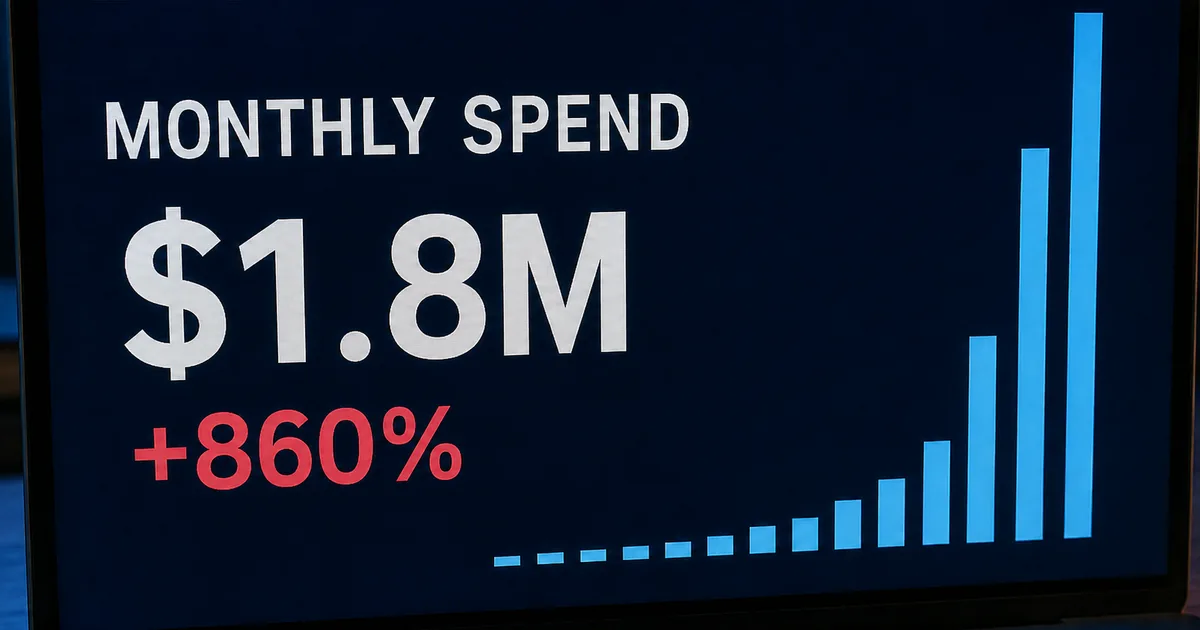
The largest reported case is unglamorous relative to its price tag. A job matching Amazon listings with author details was run with Claude Sonnet, the deployment failed, and the bill reportedly came to about $1.8 million—an 860% increase over the allocated budget.
The amount is not the interesting part. What stands out is that the problem ran for roughly five months before anyone detected it. A single job was consuming 9.6 times its budget for close to half a year without triggering anything.
Two other cases are listed: $541,000 in extra cost on a project building a financial auditing tool—an unfortunate pairing—and $134,000 in extra spend on a system meant to reduce delivery times across the logistics network.
Amazon has several internal reports that show how AI is causing the company to overspend on various projects. The Financial Times reports that the cost overruns reached $1.8 million, and that is just for one project. / The biggest blunder, so far, is the $1.8-million bill that came from a failed Claude Sonnet AI deployment, which was supposed to match author details with listings on Amazon, representing an 860% increase over the allocated budget that was only detected some five months after the issue started happening. Other problems that surfaced include a $541,000 additional cost that came from a project building, ironically, a financial auditing tool, and a $134,000 extra expense for a system designed to reduce delivery times in the company’s logistics network. — From the breakdown of the reported overruns and the time it took to detect them
Amazon calls it cherry-picking
The company's own account is reported alongside. In an internal presentation, Amazon said it is experimenting, learning and improving how it uses the technology, including how it drives cost efficiencies, the same as with any new technology.
It then challenged the framing. Cherry-picking small, isolated examples where teams are learning from one another, and portraying them as business as usual, does not reflect how teams across Amazon use AI—that is the substance of the pushback.
Scale is part of the argument. The company's latest quarterly revenue is put at more than $181 billion, which means these excess expenses amount to less than 0.1% of what it earns in a month. For Amazon, in other words, this sits closer to tuition than to damage.
“As with any new technology, we’re experimenting, learning and improving how we use it, including how we drive cost efficiencies,” Amazon said in an internal presentation, according to FT. “Cherry-picking small, isolated examples where teams are learning from one another and portraying them as business as usual doesn’t reflect how teams across Amazon are using AI.” And even though overspending more than a million dollars on failed AI projects might seem excessive for the average person, the tech giant’s latest quarterly revenue sits at more than $181 billion, meaning these excess AI expenses don’t even account for 0.1% of what it makes in a month. — From Amazon's stated position and the comparison with its revenue scale
What actually changed
More important than the size of the numbers is that the price of the same mistake changed. That part applies at any scale.
Failure went from nearly free to billed per attempt
The reporting condenses into a single line. These mistakes used to be trivially cheap, and AI models made them catastrophically expensive.
Picture a runaway loop or a retry storm in conventional software. What it burned was CPU time on your own servers, and the extra invoice was close to zero. Now run the same runaway through token-billed model calls. A token is the unit of text an AI reads and writes, and billing scales with that volume. So every retry stacks another external payment on top.
Then agents entered the picture. The reporting points to a sharp rise in token spending driven by the deployment of AI agents. An agent keeps trying on its own until it reaches its goal. The worse it goes, the more calls it makes—and that property is what turns failure expensive.
These mistakes used to be “trivially cheap,” but AI models made them “catastrophically expensive,” especially as token spending drastically increased with the deployment of AI agents. — From the observation that the cost of mistakes has fundamentally changed
Five months of not noticing is the real defect
The $1.8 million draws the eye, but the design flaw is the detection lag. If nothing escalated until spend passed 860% of budget, then either no threshold alert existed or nobody was watching the one that did.
Old instincts may be part of it. A failed job used to announce itself by not working. An AI call does not stop when it fails. It returns something plausible, retries, and keeps billing. Being broken shows up only on the invoice—which is a readable explanation for that five-month figure.
The countermeasures are not difficult. Set a per-project spending cap, emit a daily consumption alert, and watch the gap between expected and actual call volume—all standard budget hygiene. It is common enough for the whole practice to be dropped simply because the spending moved to AI.
If your usage data can be exported as a line-item file, just opening the daily token consumption or the per-project breakdown is often enough to spot where it spiked.
Make usage a contest and usage is what grows
There is also a point about incentive design. Amazon reportedly ran an internal leaderboard showing which employees used AI the most, but dropped it once spiraling AI costs prompted a rethink.
That detail is instructive. If the thing you measure is usage, what grows is usage—not results. The reporting also cites Uber's chief technology officer saying there is no link between a policy of pushing AI use and shipping successful products.
Permissions come up as well. Earlier this year AWS reported several outages driven by AI coding bot blunders, and addressed them by limiting agent access rather than granting agents the same permissions as the senior engineers they are tied to. How far an agent's reach extends matters more than what you ask it to do—the same question raised by Anthropic's disclosure of real-world intrusions found during evaluation.
This is not the first time that AI-related issues have cropped up in Amazon’s workflow. Earlier this year, AWS reported several outages that were driven by AI coding bot blunders, but the company fixed this by limiting the access of AI agents instead of giving them the same permissions as the senior engineers that they’re tied to. It also used to have an internal leaderboard that showed which employees used AI the most, but has since dropped it as spiraling AI costs made them think twice about the policy. / Many tech companies have been pushing their people to use AI, supposedly to increase productivity through tokenmaxxing. However, the Uber CTO said that there is no link between this policy and shipping successful products. — From the passages on dropping the internal leaderboard, restricting agent permissions, and the link between usage policy and results
The giants are not where this bites
Reading this as an Amazon blooper reel loses the most important part.
The exposure belongs to whoever burns a year of budget in weeks
The reporting draws the line clearly. As agents took over and AI providers moved from subscriptions to per-token pricing, costs grew large enough that companies are using up annual budgets in a matter of weeks. And while this may not be an immediate issue for tech giants like Amazon and Microsoft, it is unsustainable for most other companies.
That 0.1% ratio simply inverts. The same $1.8 million means something entirely different to a company with $181 billion in quarterly revenue than to one with a few million in annual sales. What a giant absorbs as tuition is, for everyone else, the line where operations stop.
And as agents took over and AI providers switched from subscription to per-token models, costs have become so great that companies are using up their annual budgets in a matter of weeks. While this might not be an immediate issue for tech giants like Amazon and Microsoft, it is unsustainable for most other companies out there. — From the passage on how per-token pricing inflated costs and how the impact differs by company size
Designing for fewer tokens is the cost fix
The direction of the remedy is visible too. Not using less AI, but designing for the same result with fewer calls.
There is already a concrete example. OpenAI reported that turning on two harness settings—the harness being the scaffolding a model runs inside—tripled its scores on the public task set while cutting output tokens by a factor of six. That is a demonstration that performance and cost are not necessarily a trade-off. Pointing the same way: reducing Claude Code's startup token overhead and choosing models with their unit-price differences in mind.
In the case of ARC-AGI-3, we discovered that turning on two API settings we use in ChatGPT and Codex—retained reasoning and compaction—tripled scores and cut output tokens by 6x on the public task set. — From the description of how the setting change affected scores and output tokens
Summary: the figures are reported, the structure is yours
To repeat: every dollar figure here comes from the Financial Times reporting as relayed by Tom's Hardware, not from Amazon. The company disputes the framing as cherry-picking, and there is something to that objection. These are best not treated as settled numbers.
The structure, though, transfers directly to your own environment. Every failure is billed, an agent makes more calls the worse things go, and being broken surfaces only on the invoice. Where those three line up, the same thing happens at any size.
What to do about it is unremarkable. Cap spending per project, review consumption daily, and detect the gap between expected and actual volume. None of that differs from ordinary budget control. What changed is that one new path now exists along which spend grows by itself. Whether your existing monitoring is connected to that path is the question this reporting actually poses.