The first airspace-wide contrail avoidance trial
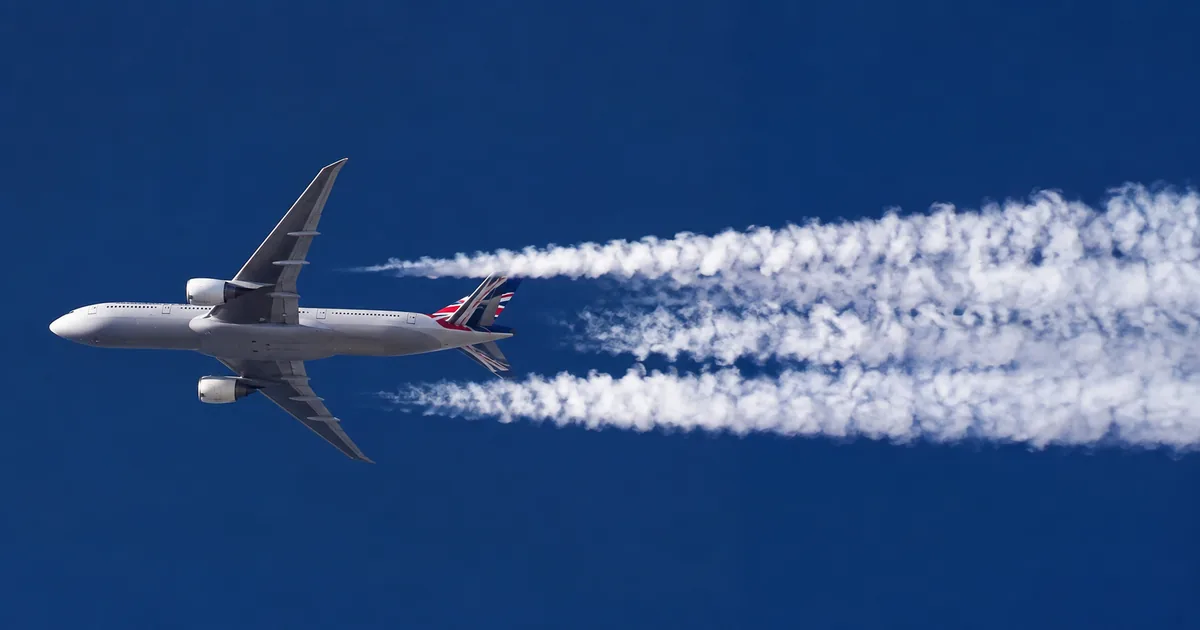
A contrail is jet exhaust that froze. Up where the air is cold and damp, water vapour in the exhaust freezes onto soot and other aerosols. Some of those trails do not last. Others persist as thin cloud, and it is the persistent kind that matters here. Operation Blue Skies is a test of whether aircraft can be routed around the layers where that second kind forms.
Individual airlines have run versions of this already. Google has worked with American Airlines, with EUROCONTROL's MUAC on the European side, and with flight-planning vendors including FlightKeys, enough to argue that contrail avoidance holds up both scientifically and operationally. What changes now is coordination: a whole corridor moving together instead of one carrier at a time.
"Since publishing our initial research on ways AI can help mitigate contrail warming, we've partnered across the aviation industry, working alongside airlines such as American Airlines, air navigation service providers like EUROCONTROL's MUAC, and Flight Planning Software providers including FlightKeys, to demonstrate that avoiding warming contrails is both scientifically validated and operationally practical." (body) — from Google's official blogView official source →
"Contrails form when water vapour in jet-engine exhaust condenses and freezes around soot particles and other aerosols in the cold, humid air of the upper atmosphere."/"A UK-based consortium will conduct the world’s first airspace trial aimed at reducing condensation trails – known as contrails – that could greatly reduce aviation’s global warming impact." (body) — from the University of CambridgeView official source →
Shanwick airspace, and about 10,000 flights a year
The trial airspace is Shanwick, the eastern half of the North Atlantic corridor, controlled by NATS in the UK. Around 10,000 flights from hundreds of cities pass through it during trial hours each year. Only a small percentage of those — the ones heading for contrail-sensitive air — are deviated at all.
"Now, we’re taking the next major step: expanding beyond individual airline trials to coordinated contrail mitigation across an entire flight corridor. We’re launching Operation Blue Skies — the world’s first state-backed trial to avoid contrails at the scale of an entire oceanic airspace."/"The 30 month program consists of two operational trials, each lasting approximately four months. Around 10,000 flights, originating from hundreds of cities, will pass through Shanwick airspace during trial hours each year and a small percentage of these flights that would otherwise pass through contrail-sensitive airspace will be slightly deviated, preventing them from forming strongly warming contrails." (body) — from Google's official blogView official source →
The intervention is a small altitude change
Nothing about the manoeuvre is dramatic. It is a minor altitude adjustment inside standard flight operations, passed through the air traffic control channels controllers already use. No new procedure, no special handling. The manoeuvres sit mainly in the winters of 2026-2027 and 2027-2028, roughly 20 to 40 test days each, and only during quieter traffic periods.
NATS owns the safety assessment and the controller training. Asking for an ordinary altitude change rather than a special exercise is what makes the trial plausible to run at all.
"The trials will focus on minor altitude adjustments within standard flight operations, coordinated through established and standard Air Traffic Control (ATC) communication channels. Trial manoeuvres will take place primarily during winter testing windows in 2026-2027 and 2027-2028, with approximately 20 to 40 test days per winter. Testing will be conducted during periods of lower air traffic." (body) — from the University of CambridgeView official source →
Why contrails are a climate problem at all
A line in the sky reads as harmless. It is not, and the mechanism has nothing to do with the carbon dioxide coming out of the same engine.
Contrails carry roughly a third of aviation's climate impact
Persistent warming contrails trap heat leaving the surface. Added up, that puts contrails at roughly one third of aviation's total climate impact. Which is why routing around the air that makes them is a separate lever from burning less fuel.
Google points to research suggesting contrail avoidance could be among the most cost-effective ways to cut aviation's climate impact. Professor Steven Barrett, on the Cambridge side, goes further: contrail avoidance could drastically reduce aviation's global climate impact, at minimal cost to passengers and companies. No fleet replacement, no fuel switch. Neither announcement explains why the cost would be so low.
"When you look up at a clear sky and see thin white lines trailing behind airplanes, you’re looking at condensation trails, or "contrails." These are clouds created when water vapor condenses around soot particles in jet exhaust. While they may seem harmless, these warming contrails account for roughly one third of aviation’s total climate impact."/"Contrails are one of the most urgent yet solvable climate challenges facing aviation today. Research suggests that avoiding contrails could be one of the most cost-effective ways to reduce aviation’s climate impact." (body) — from Google's official blogView official source →
"Contrail avoidance could drastically reduce the global climate impact of aviation, at minimal cost to passengers and companies,” said Professor Steven Barrett, Regius Professor of Engineering at the University of Cambridge." (body) — from the University of CambridgeView official source →
Winter over Shanwick holds the contrail warming
Why Shanwick, and why winter. Atmospheric modelling puts Shanwick airspace alone at about 5% of global contrail warming, and a significant part of that sits in the months from November to February. The problem concentrates in both place and season, which is what makes a bounded trial worth running.
The AI model's job is to narrow it further — finding where and when an intervention removes the most contrail-related warming.
"Atmospheric modelling shows that the Shanwick airspace accounts for approximately 5% of global contrail warming. A significant part of this warming is concentrated in the winter season between November and February. Operation Blue Skies will target this specific high-impact window by using AI models to identify where and when interventions have the greatest potential to reduce contrail-related climate impact." (body) — from the University of CambridgeView official source →
Who is in the consortium and what each brings
Avoiding contrails across an airspace needs a forecast and a set of controllers willing to act on it. The membership reads that way.
Who predicts and who checks the result
Operation Blue Skies partners and roles
Google verifies its own impact with machine learning and satellite imaging. The independent verification of climate impact, though, belongs to Imperial College London and Cambridge — the party doing the predicting does not get to close the loop on its own.
"Google UK: Developing AI models to predict and avoid warming contrails, while using machine learning and satellite imaging to track and verify our impact."/"NATS (the UK's leading air navigation service provider): Trial airspace operations, air traffic control coordination, safety assessment and air traffic controller training."/"Imperial College London & University of Cambridge: Evaluating trial outcomes and providing independent verification of climate impact."/"Contrails.org: Leading forecast assessments, designing trial parameters, and supporting data analysis."/"Met Office: Developing a new UK contrail forecast capability and ensuring meteorological accuracy throughout the trial."/"Operation Blue Skies programme is co-funded by its industry partners and the Department for Transport (DfT) through the ATI Programme, a partnership between the Aerospace Technology Institute (ATI), the Department for Business, Innovation, Science and Trade (BIST) and Innovate UK." (A landmark consortium for global impact) — from Google's official blogView official source →
The UK government funds most of the £5 million
The money is itemised on the Cambridge side. Operation Blue Skies is a £5 million, 30-month programme, and £2.65 million of that comes from the Department for Transport. Industry partners cover the rest. All of the government grant funding goes directly to academic, non-profit and aviation partners. Cambridge gives the reason for that routing: public money should build domestic scientific capability.
Google UK is in pro bono. Its £1.4 million contribution is in kind: AI research expertise, engineering time, and high-performance computing. It is putting in people and compute rather than cash, on the open-science side of the ledger. We covered the same move — compute and expertise handed into research rather than sold to it — in Claude Science.
"Operation Blue Skies is a £5 million, 30-month programme, partly funded by £2.65 million from the Department for Transport."/"To ensure public funding directly advances sovereign scientific capabilities, 100% of the government grant funding is allocated directly to academic, non-profit, and aviation partners."/"Google UK is contributing £1.4 million in-kind through AI research expertise, engineering time, and high-performance computing infrastructure to advance open climate science." (body) — from the University of CambridgeView official source →
"Google UK is participating on a pro-bono basis, contributing £1.4 million in-kind through AI research expertise, engineering time, and high-performance computing infrastructure to advance open climate science." (body) — from Google's official blogView official source →
The two announcements describe one programme with different numbers in each. Flight counts appear only in Google's; the £5 million total, the £2.65 million from government, and the trial windows appear only in Cambridge's. Only the £1.4 million in-kind figure appears in both. Pulling both pages into markdown keeps each document's headings and lists intact while you check one against the other.
What contrail avoidance still has to prove
Contrails account for roughly a third of aviation's climate impact and may be avoidable by flying a little higher or lower. Operation Blue Skies is the first attempt to show that across an entire airspace: Shanwick, which holds about 5% of global contrail warming, in the winter months where the warming concentrates, using AI forecasts to pick the altitude changes worth making. The UK Department for Transport covers £2.65 million of the £5 million, and Google contributes £1.4 million in kind. Imperial College London and Cambridge hold the independent verification, and nothing is settled until the trials finish. The first of the two operational trials falls in the winter of 2026-2027.