What Cerebras announced with the CS-4
Cerebras builds AI accelerators out of a single wafer rather than dozens of separate chips, and the CS-4 is the fourth generation of that system. The announcement covers three things at once: a new processor, a new rack, and a set of speed claims that need reading carefully.
CS-4 system figures, as published
Three wafer scale engines in one rack, on a new platform
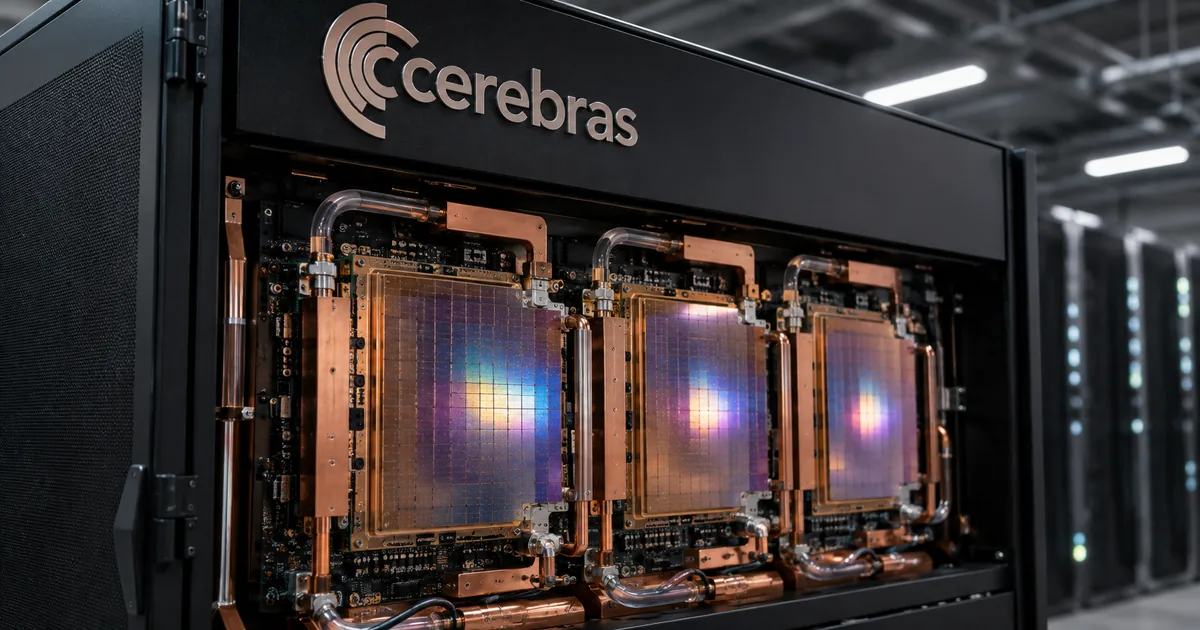
The CS-4 is a rack-scale machine rather than a card you add to a server, and it is the first system on what Cerebras calls the Nexus platform architecture. Nexus splits the rack into three modules—compute, power, and I/O—so that each can be revised without waiting for the others. That modularity is the reason the company gives for faster manufacturing and installation. It also means a wafer upgrade can reach customers without a full rack redesign.
"The CS-4 is a rack-scale solution built from three new Wafer Scale Engines and revolutionary rack and system designs. The CS-4 is the first member of the next-generation Cerebras Nexus rack-scale platform architecture." / "The rack scale CS-4 is built from three of the newly released Wafer Scale Engine 3 Turbo (WSE-3T). The CS-4 delivers 750 PFLOPs of AI compute, 7.2 terabits per second of I/O, and 129.6 petabytes per second of memory bandwidth. Total compute fabric bandwidth jumps to 160.5 petabytes per second, and wafer to wafer latency drops as low as two microseconds, enabling the creation of very large clusters and the support of models with over 50 trillion parameters." / "I/O latency shrinks from five microseconds to as low as two microseconds." (A New Processor) — from the Cerebras press releaseView official source →
"Today, we are introducing the fourth generation of our Cerebras System: CS-4." / "With 50 percent fewer components and self-contained assemblies for compute, power, and I/O, CS-4 supports faster manufacturing and rapid deployment. Instead of treating the rack as a tightly coupled collection of parts, Nexus turns it into a platform of purpose-built modules." / "That platform approach also creates a cleaner path for upgrades, allowing innovation in one part of the system to reach customers without waiting for every other part to be redesigned." — from the Cerebras blog postView official source →
The WSE-3 Turbo doubles compute and memory bandwidth
The processor inside is the WSE-3 Turbo, a revision of the WSE-3 rather than a new generation of silicon. It keeps the four trillion transistors and 900,000 cores of its predecessor and doubles two things that matter for serving: compute per wafer and memory bandwidth. Cerebras is explicit that the second one is what moves token speed, since decoding is bound by how fast weights can be read rather than by raw arithmetic.
"Like the WSE-3, the WSE-3T is the largest AI processor ever built, containing four trillion transistors and 900,000 AI-optimized cores across 46,225 square millimeters of silicon, with 44GB of SRAM integrated directly on the wafer." / "The WSE-3T doubles AI compute to 250 PFLOPS per wafer and doubles memory bandwidth to 43.2 petabytes per second. And since memory bandwidth is the determining factor in driving speed and throughput, this translates to a step-change improvement in both." — from the Cerebras press releaseView official source →
What the 30x inference speed claim measures
The figure traveled as a headline on the day. The number is real, and it is also narrower than the headline suggests, because it is one comparison on one model.
It is a head-to-head run on GPT-OSS-120B
The measured claim is this: on GPT-OSS-120B, given identical prompts, the CS-4 produced more than 4,400 tokens per second for a single user, which Cerebras puts at up to 30 times faster than GPU solutions. Hold onto two details. The metric is tokens per second per user. It describes how fast one response streams, not how much a rack produces in aggregate. Cerebras CTO Sean Lie frames the gain as more than a faster-feeling reply: the same wall-clock second buys an agentic system more than an order of magnitude more reasoning, verification, or tool use. And the comparison is against GPU systems, not against the previous Cerebras machine—against the CS-3, the same release claims up to twice the speed.
"In a head-to-head comparison on GPT-OSS-120B, when given identical prompts, the CS-4 delivers [1] more than 4,400 tokens second per user (TPS/user), up to 30 times faster than GPU solutions." / "It is up to twice as fast as the CS-3, bringing the CS-4s advantage in tokens-per-second-per-user over GPUs to up to 30x more." / "Being 30 times faster doesn’t just make a response feel fast. It gives an agentic system room for more than an order of magnitude as much reasoning, verification, or tool use in the same wall-clock time," / "Actual throughput varies by model architecture, context length, precision, and serving configuration." — from the Cerebras press releaseView official source →
Cerebras labels what is measured and what is projected
The blog post is unusually careful about provenance, and reading the small type under each chart changes how much weight each figure carries. The 30x chart is sourced to Artificial Analysis, a third-party measurement service, alongside internal benchmarking. The claim about models beyond 10 trillion parameters is an extrapolation, and Cerebras labels it as one. Under the CS-3 capacity comparison: internal benchmarking and projections. None of that makes the numbers wrong, but only the first is a measurement of a shipping system.
"Source: Artificial analysis and internal benchmarking (August 2026)" / "With this low-latency communication, CS-4 can deliver more than 1,000 tokens per second on models exceeding 10 trillion parameters." / "Low-latency wafer-to-wafer communication preserves interactive decode performance as model size grows. Source: extrapolation from internal benchmarking (August 2026)." / "The CS-4 solution generates tokens up to 30 times faster than production GPU systems while delivering up to 10 times more throughput per watt than CS-3." / "CS-4 expands the ultrafast inference frontier with up to 10x more token capacity and up to 2x faster performance than CS-3. Source: internal benchmarking and projections (August 2026)." — from the Cerebras blog postView official source →
Where the speed comes from
Cerebras frames the CS-4 as a system-level result rather than a faster chip dropped into an old chassis, and the two changes it points to are physical ones.
The backpack cuts installation from days to hours
The compute subsystem now hangs off the back of the power array as a self-contained assembly that Cerebras calls a backpack. Power conversion, liquid cooling, I/O, and control electronics all wrap around the wafer inside it. Decoupling compute from the power supplies is what shortens deployment. The same redesign moves power conversion from roughly 50 millimeters away to about half a millimeter. Shorter distance means less board-level loss, which is how the company gets twice the power into the processor and, with it, higher clocks.
"a rear mounted “backpack” that attaches vertically to the power array." / "Each Wafer-Scale Backpack is a self-contained assembly that folds power conversion, direct liquid cooling, high-speed I/O, and control electronics into a compact, three-dimensional package built directly around the wafer." / "By decoupling compute from the power supplies, the Wafer-Scale Backpack simplifies manufacturing and reduces deployment time from days to hours. Compared with the prior-generation system, the Wafer-Scale Backpack has 50% fewer components and uses 60% more automated manufacturing." / "For example, by moving power conversion 100x closer to the processors – from roughly 50 millimeters away from the processor as on conventional GPU boards to approximately 0.5 millimeters – CS-4 nearly eliminates board-level power loss. This delivers twice as much power to the WSE-3T, enabling higher operating frequencies and faster token generation." — from the Cerebras press releaseView official source →
Prefill can run on someone else's hardware
The CS-4 also supports disaggregated inference, which splits a request in two. A prefill engine reads the prompt and prepares the model state, then hands that state to the CS-4, which does the decoding. Cerebras names AMD Helios and AWS Trainium as platforms it expects to sit on the prefill side. The practical reading is that Cerebras is selling decode speed inside a mixed rack rather than asking operators to replace what they already run. Hardware built for one half of inference is a pattern worth watching—OpenAI's Jalapeño inference chip with Broadcom is the same idea from the model side, and GPT-5.6 Sol Ultrafast shows what a provider does once the speed exists.
"First, a purpose-built prefill engine processes the incoming prompt and prepares the model state. That state is then transferred to CS-4, where the system performs ultra-low-latency decoding and generates the response." / "For operators, this architecture combines industry-leading Cerebras decode performance with the flexibility to pair CS-4 with complementary prefill platforms, including AMD Helios and AWS Trainium." — from the Cerebras blog postView official source →
What is still unclear
Two gaps stay open. The first is the size of model the system is claimed to serve. The blog post talks about delivering more than 1,000 tokens per second on models exceeding 10 trillion parameters. The press release says the architecture supports models with over 50 trillion parameters. Those are different claims about different things—sustained speed versus supported capacity—and neither document reconciles them, so treat 10 trillion as the figure attached to a performance number.
The second is commercial. First shipments are stated for this quarter, but there is no price, no general availability date, and no named CS-4 customer in either document. If you're sizing a deployment, the datasheet is the only place the full specifications live. Carry the 30x figure into a procurement conversation with its measurement condition attached, not on its own.
"First CS-4 shipments begin this quarter. Full system specifications are available in the CS-4 datasheet at https://www.cerebras.ai/cs4-datasheet." (Availability) — from the Cerebras press releaseView official source →