What MiniMax H3 is
MiniMax H3 is a model from the Chinese AI company MiniMax that generates video and audio together. The company calls it a general-purpose omni-modal generation system. Omni-modal here means it takes inputs of different kinds — text, images, video, audio — without separating them, handling the lot as one stream.
MiniMax H3 output specification (from the official model card)
| Item | Specification |
|---|---|
| Duration | 4–15 seconds |
| Resolution | Shorter side 768px by default (2K via H3-Regenerate-2K) |
| Frame rate | 24fps |
| Audio | 32kHz stereo |
| Aspect ratios | 21:9 / 16:9 / 4:3 / 1:1 / 3:4 / 9:16 and others |
| Spoken languages | Stable support for 11, including Japanese, English, and Chinese |
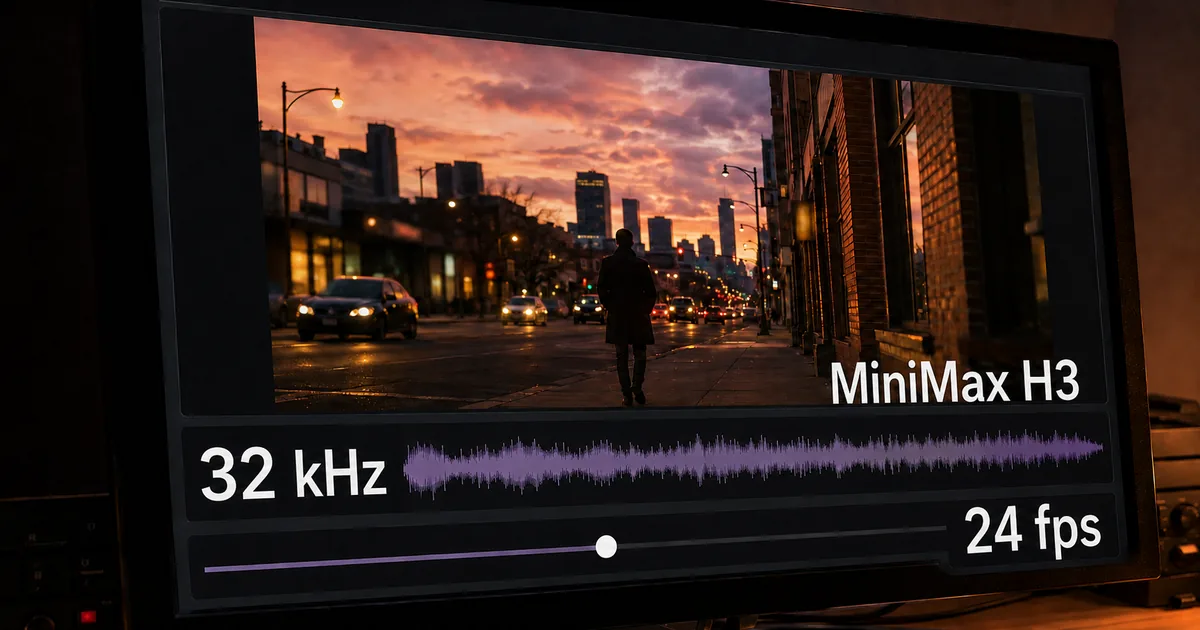
It supports unified understanding of multimodal contexts composed of text, images, video, and audio, and can generate video with native stereo audio at resolutions up to 2K and durations of up to 15 seconds. / Output duration | 4–15 seconds / Output aspect ratio | Supports a wide range of aspect ratios, including but not limited to 21:9, 16:9, 4:3, 1:1, 3:4, and 9:16 / Output resolution | Supports various resolution dimensions. The shorter side is set to 768 pixels by default. / Output frame rate | 24 FPS / Output audio | 32 kHz stereo / Supported dialogue languages | Stable support for 11 languages: Arabic, Chinese, English, French, German, Italian, Japanese, Korean, Portuguese, Russian, and Spanish. Additional languages are also supported to varying degrees — From the opening overview and every row of the output specification table
Video and audio are not made separately and stitched afterwards
The distinctive part is that video and audio are generated together in the same stream. Rather than producing footage and adding sound in a later pass, a single Transformer — the architecture that reads a whole context and predicts what comes next — jointly predicts the video and audio latents, which are then decoded into video and stereo audio. Structurally there is no step where the two get aligned after the fact.
The core, H3-Omni-Transformer, is a single 33B-parameter dense model. About 13B of those parameters sit in branches related to AdaLN, a modulation mechanism, and MiniMax states these do not need to be loaded for inference-only deployment — inference being the act of running a trained model to get an answer. For understanding text, the full pretrained weights of Qwen3-VL-32B are used as they are, with the hidden states from its 50th layer passed into the core.
One caveat: native sparse attention, the mechanism that keeps the compute cost of long inputs down, was introduced in the final stage of training but is not part of this release. The public weights run with full attention only, revisiting the entire input every time.
H3-Omni-Transformer is a 33B-parameter dense, single-stream Transformer, with approximately 13B parameters residing in AdaLN-related branches. Because the AdaLN modulation outputs can be precomputed and cached, these parameters do not need to be loaded for inference-only deployment. / The H3-Encoder uses the full pretrained weights of Qwen3-VL-32B and provides the hidden states from its 50th layer to the H3-Omni-Transformer. / During the final stage of training, we introduce native sparse attention to reduce the computational cost of long sequences. / The initial open-source release provides inference with full attention only. / The H3-Omni-Transformer jointly predicts video and audio latents, which are then decoded into video and stereo audio, respectively. — From the size of the core and the treatment of AdaLN, the text encoder, when sparse attention arrived and what the release actually ships, and the joint prediction of video and audio
Up to 12 reference files across images, video, and audio
Two checkpoints — complete sets of trained weights — were released, and they differ in how you feed them input.
The two checkpoints and how input works
Audio cannot stand alone as an input; it has to accompany an image or a video. Being able to pass several pieces of reference material is what matters when you want an existing character or product to appear.
Seedance 2.5, released by ByteDance around the same time, allows up to 30 images, 10 videos, and 10 audio clips. But it does not publish weights — you use it through the service. How much material you can hand over and whether you can run it yourself are two separate axes. Before you pass material in, matching your source aspect ratios to the output ratio avoids unintended cropping.
Supports zero, one, or two input images. / - No image input: Text-to-video mode / - One image input: First-frame-to-video or last-frame-to-video generation / - Two image inputs: First-and-last-frame-to-video generation / Supports multi-modal reference inputs: / <strong>Images:</strong> ≤ 9 images / <strong>Videos:</strong> ≤ 3 clips; each clip must be 2–15 seconds long; total duration ≤ 15 seconds / <strong>Audio:</strong> ≤ 3 clips; audio must be accompanied by image or video input and cannot be used as the sole input; each clip must be 2–15 seconds long; total duration ≤ 15 seconds / <strong>Mixed inputs:</strong> Maximum number of files across all input types is 12 — From the per-checkpoint input specification table, the H3-Base-FL2VA (first-and-last-frame mode) and H3-Base-Ref2VA (omni-reference mode) rows
The licence and where MiniMax H3 can be used
This model's licence is bounded geographically. Open-weight models that limit territory in the licence text itself are still rare. Since it goes straight to whether you can adopt it, the text is worth reading first.
Scope of the MiniMax H3 Community License Agreement
MiniMax H3 release date/License date: August 2, 2026. / The scope of this License Agreement (this "Agreement") is expressly limited to the "Applicable Territory" as defined below. / "Applicable Territory" means worldwide, excluding the Excluded Territories. / "Excluded Territories" means the European Union, the United Kingdom, the Republic of Korea and the United States of America. / "We," "Us" or "MiniMax" means Nanonoble Pte. Ltd.. — From the licence date, the definitions of Applicable and Excluded Territory, and the definition of the licensor
The US, EU, UK and South Korea are out; Japan is in
The text defines the territory as worldwide minus the Excluded Territories. Those are the European Union, the United Kingdom, the Republic of Korea, and the United States. Japan is not on the list, so domestic use in Japan sits inside what the licence contemplates.
Handling outside that scope is prohibited in plain terms. Using, reproducing, modifying, distributing, or displaying the model or its outputs outside the Applicable Territory is not authorised by the agreement. Even for a Japanese company, a setup that runs it from a US or European office, or that distributes output into an excluded territory, needs the text read carefully.
You may not use, reproduce, modify, distribute, or display the MiniMax H3 Works or any of their Outputs or results outside the Applicable Territory. Any such use outside the Applicable Territory is not authorized by this Agreement. — From the clause prohibiting use outside the Applicable Territory
MiniMax explains why it drew the line where it did
The unusual part is that MiniMax documents its reasoning for excluding those four. It places the reason in the regulatory environment. Video generation models face a more complex and faster-moving set of rules than text or code models, covering likeness, copyright, and content safety. The EU AI Act has begun enforcement while practical requirements for models that can generate video and likeness-related content are still evolving. Similar uncertainty exists in the UK and South Korea, and in the US the company is itself a party to ongoing copyright proceedings specifically about generative video AI.
Given that, MiniMax says it faced a choice between waiting for regulatory clarity everywhere and releasing now with a transparent licence scope, and took the second. The current restriction, it writes, means "not yet", not "not ever." Organisations in excluded regions can apply for a formal licence and may be authorised after review. The API is globally available, so trying it without holding weights is possible even from an excluded territory.
The current territory scope is not about excluding specific countries or regions, but about recognizing that video generation models are facing a more complex and rapidly evolving regulatory environment compared with text or code models. / The EU AI Act has started enforcement, while practical requirements for models capable of generating video and likeness-related content are still evolving. / Similar regulatory uncertainties exist in the UK and South Korea regarding AI-generated content and video generation. / In the US, AI regulation remains a rapidly changing landscape, and MiniMax is also involved in ongoing copyright-related legal proceedings specifically concerning generative video AI. / We had two options: 1. Wait until every jurisdiction reaches complete regulatory clarity before releasing open weights, which could take a long time while AI technology continues to evolve. 2. Release the model now with a transparent license scope, while continuing to evaluate and expand availability. We chose the second approach. / The current limitation means "not yet", not "not ever." / API: Globally available with built-in safeguards and responsible-use controls. / Organizations in these regions can apply for a formal license. / After reviewing the deployment scenario and confirming that appropriate compliance controls and safeguards are implemented, MiniMax may authorize usage. — From the stated reason for limiting the territory, the choice between the two options, the scope of the API, and the application route for organisations in excluded regions
Commercial use is allowed, with a revenue threshold and a display duty
Commercial use itself is permitted, subject to two conditions. The first is a revenue line: if your commercial products and services generate more than 20 million US dollars in yearly revenue, you must obtain separate prior written authorisation from MiniMax. The contact address and even the subject line are specified in the text.
The second is attribution. A commercial product or service built on H3 must display "MiniMax H3" prominently in its user interface. Using it quietly in the background without surfacing it does not comply. The wider push toward marking where generated material came from runs through efforts like NVIDIA's synthetic video detector as well.
You shall obtain a separate, prior written authorization from MiniMax by contacting api@minimax.io with the subject line "MiniMax H3 licensing - authorization request", if your commercial products and services generate more than 20 million US dollars (or equivalent in other currencies) in yearly revenue. / You shall prominently display "MiniMax H3"on the user interface of commercial product or service that uses MiniMax H3 or MiniMax H3 Works. — From the revenue threshold and the display duty in the additional commercial terms
Running MiniMax H3, and what was held back
Having the weights does not mean the public release alone matches the quality of the official demos. Testing it while assuming otherwise produces a mismatch with expectations.
The three modules and what was released
What is missing is the entrance and the exit
Only the middle piece, H3-Base, was released. H3-Context-IR at the front was left out because it depends on a multi-stage workflow and several hosted models and services. MiniMax states outright that this module is critical to the quality of the final output, and points users at either the API or the prompting guidance for building their own context-processing system.
H3-Regenerate-2K at the back is also unreleased. It is not conventional super-resolution — mechanically enlarging pixels — but a pass that feeds the 768p result and the original context back into the model to regenerate at 2K, which the company says lets it recover small text and fine detail from context rather than guesswork. It will be published once ready, but for now anything that stays entirely local tops out at 768p.
Because H3-Context-IR relies on a multi-stage workflow and multiple hosted models and services, it is not included in this open-source release. We provide an API that enables users to reproduce the behavior of the official workflow. / H3-Context-IR is critical to the quality of the final output, so we strongly recommend incorporating it into your generation pipeline or following the "Prompting Guidance" to build your own context-processing system. / instead of using a conventional dedicated super-resolution module, we use the H3 base model to regenerate its own low-resolution result through an in-context manner. / allowing it to recover information that conventional super-resolution methods would otherwise have to "guess," such as small text and fine details / Due to the complexity of the system, this module is not yet open-sourced. We will release it once it is ready. — From the reasons the modules were held back, their effect on quality, and how 2K regeneration differs from conventional super-resolution
It runs on SGLang, vLLM, diffusers, and ComfyUI
The runtime side is well covered. MiniMax recommends four inference frameworks — SGLang, vLLM, diffusers, and ComfyUI — with links from the model card to documentation or setup steps for each. ComfyUI, where you assemble a pipeline by wiring nodes on screen, comes with an official tutorial and two workflow templates, so there is a route to trying it without writing code.
The weights are split across two checkpoints, so you can scope the download to the side you need. Numerical precision is BF16 — a memory-efficient 16-bit format — for both, and the distributed weights have already been CFG-distilled to cut the number of generation steps.
MiniMax H3 is released as two task-specific checkpoints. / Video and audio|BF16 / scope the download to what your framework needs / We recommend the following inference frameworks to serve the model: / [ComfyUI](https://github.com/Comfy-Org/ComfyUI) - see [Comfy tutorial](https://docs.comfy.org/tutorials/video/minimax/minimax-h3); use [R2V template](https://github.com/Comfy-Org/workflow_templates/blob/main/templates/video_minimax_h3_r2v.json) / [T2V template](https://github.com/Comfy-Org/workflow_templates/blob/main/templates/video_minimax_h3_t2v.json) / The released checkpoints are CFG-distilled Omni Transformer model weights. — From the checkpoint structure, the BF16 precision column, the note on scoping the download, the recommended framework list including the ComfyUI row, and the nature of the distributed weights
Conclusion: how to place MiniMax H3
Two things matter here. One is the design decision to generate video and its audio in a single model at once, which starts from a different premise than the conventional make-them-separately-and-align flow. The other is the territorially bounded licence: excluding the US, EU, UK and South Korea shows that open-weight distribution is starting to have lines drawn around it from the regulatory side. Japan being inside the Applicable Territory means being inside that line.
If you are evaluating it, start by confirming 768p output from the released H3-Base. The 2K quality in the official demos assumes the unreleased modules, and keeping the two apart is what lets you read your results correctly. If it is going into a commercial product, settle the revenue threshold and the UI attribution duty internally first so nothing has to be unwound later.
How far open-weight generative AI holds up in real work is being argued on the text side too. See our explainers on GLM-5.2 and DeepSeek V4-Flash 0731.