What DeepSeek V4-Flash 0731 is
DeepSeek-V4-Flash-0731 is a large language model published on July 31, 2026 by the Chinese AI company DeepSeek. It is positioned as the official release that replaces the preview version available until then. Note that the release date does not appear in the model card text itself—the commit history of the Hugging Face repository shows the initial commit on July 31, 2026, and the "0731" in the name matches that date.
DeepSeek-V4-Flash-0731 at a glance (per the official model card)
reasoning_effort = low / high / maxhigh / max)DeepSeek-V4-Flash-0731 is the official release of DeepSeek-V4-Flash, superseding the preview version, with substantially enhanced agentic capabilities. / This repository and the model weights are licensed under the MIT License. / The `reasoning_effort` parameter now supports three levels — `low`, `high`, and `max` — which control how much deliberation the model spends before answering. / For the `high` and `max` reasoning effort levels, we recommend a maximum output length of 384K tokens. — From the passages covering positioning, license, reasoning settings and recommended output length listed in the table
What got stronger is agentic capability
The axis DeepSeek builds its description around is not conversational quality but agentic capability—calling tools, writing code, and running multi-step procedures on its own. The card explicitly frames this as the official release with substantially enhanced agentic capabilities.
The architecture itself is not new. It has the same model structure as DeepSeek-V4-Flash-DSpark, which the company publishes separately, complete with a speculative decoding module (a speedup technique that drafts candidate tokens quickly and then verifies them) attached from the start. So what changed to produce the gain? The official card does not say. It states that the structure is the same and that agentic capability improved substantially, and never touches how the training procedure differed.
The technical report is titled "Towards Highly Efficient Million-Token Context Intelligence," which points at efficiency and long context as the target.
DeepSeek-V4-Flash-0731 is the official release of DeepSeek-V4-Flash, superseding the preview version, with substantially enhanced agentic capabilities. It has the same model structure as DeepSeek-V4-Flash-DSpark, i.e. it comes with a speculative decoding module attached. / title={DeepSeek-V4: Towards Highly Efficient Million-Token Context Intelligence} — From the positioning of the official release, the model structure, and the title of the technical report
Some parameter counts are not stated officially
First, the term. Activated parameter count is the number of parameters actually used to compute a single token. In a mixture-of-experts (MoE) design like this one, only a portion of the total parameters fire on each pass. So even with a large total, a small activated count means less compute and better latency. The claim that a smaller model beat the flagship refers to this number.
Care is needed here. The Hugging Face model page shows 304B as the total parameter count, but that figure is auto-aggregated by Hugging Face from the weight files in the repository—DeepSeek did not write it. And the official model card never states the activated parameter count numerically. All it offers is the comparative phrase "far smaller activated parameter count."
Some write-ups circulate "284B total / 13B activated," but that is not an officially stated figure and does not match the auto-aggregated 304B either. Whether the speculative decoding module is counted changes the aggregation scope, so neither can simply be declared wrong. This article does not treat those as settled numbers. If you plan to estimate cost or throughput from the activated parameter count, wait for official detail.
Kimi K3, another large open-weights model, does publish actual weight sizes and recommended configurations, so it is a useful point of comparison.
DeepSeek-V4-Flash-0731 outperforms DeepSeek-V4-Pro (Preview) on benchmarks listed below despite its far smaller activated parameter count, and is broadly competitive with the strongest proprietary models available. — Cited as evidence that the official text uses a comparative phrase rather than a number for the activated parameter count
What happened on the public benchmarks
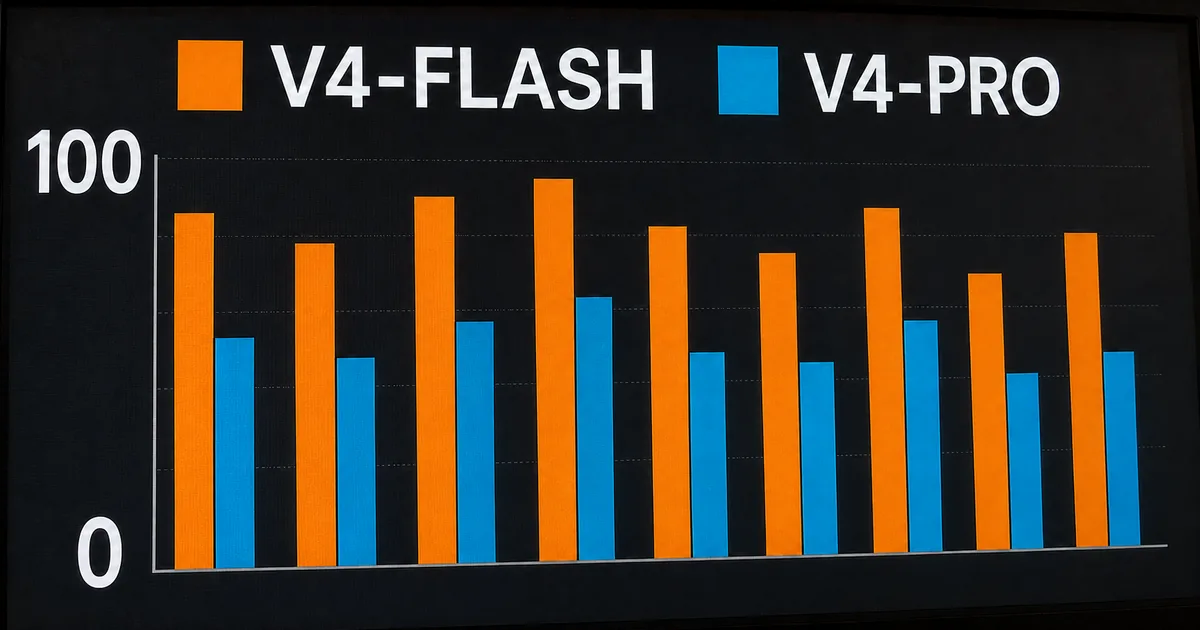
Benchmarks are the center of the announcement. The official model card presents a nine-row comparison table and claims wins over the in-house flagship DeepSeek-V4-Pro (Preview) on every row.
Benchmark comparison from the official model card (figures measured by the developer)
| Benchmark | V4-Flash-0731 | V4-Flash (Preview) | V4-Pro (Preview) | GLM-5.2 | Opus-4.8 |
|---|---|---|---|---|---|
| Terminal Bench 2.1 | 82.7 | 61.8 | 72.1 | 81.0 | 85.0 |
| NL2Repo | 54.2 | 39.4 | 38.5 | 48.9 | 69.7 |
| Cybergym | 76.7 | 38.7 | 52.7 | — | 83.1 |
| DeepSWE | 54.4 | 7.3 | 12.8 | 46.2 | 58.0 |
| Toolathlon-Verified | 70.3 | 49.7 | 55.9 | 59.9 | 76.2 |
| Agents' Last Exam | 25.2 | 15.8 | 16.5 | 23.8 | 25.7 |
| AutomationBench Public | 25.1 | 10.8 | 12.8 | 12.9 | 27.2 |
| DSBench-FullStack (internal) | 68.7 | 37.0 | 41.8 | 61.8 | 71.6 |
| DSBench-Hard (internal) | 59.6 | 25.8 | 31.1 | 54.5 | 71.7 |
The big jumps are in agentic coding
Reading down the columns, the largest gains sit exactly where the preview struggled. DeepSWE went from 7.3 to 54.4, and Cybergym from 38.7 to 76.7. That gap appeared while the architecture stayed in the same family as the preview.
The comparison models are GLM-5.2 and Claude Opus 4.8. Against GLM-5.2 it wins all eight rows where a figure is published (Cybergym has no GLM-5.2 value, so it cannot be compared). Against Claude Opus 4.8 it loses every row. The table does not say "now the strongest"—it says "near the top among open weights, with the strongest proprietary models within sight."
These figures are self-reported
Skip this section and you will misread the numbers. DeepSeek documents its measurement conditions in the notes, and two of them matter.
First, the code agent tasks among the public benchmarks were measured with the minimal mode of DeepSeek Harness as the agent framework. A harness is the execution scaffolding that hands tools to a model and lets it work through evaluation tasks. And as of that note, the harness is "to be released"—not public. Nobody outside DeepSeek can currently re-measure other models on the same footing. For tasks under this condition, the card also states reasoning_effort at max, temperature = 1.0 and top_p = 0.95.
Second, two of the nine rows—DSBench-FullStack and DSBench-Hard—are internal test sets. Their contents cannot be inspected externally, and no measurement conditions are noted for them.
None of this means the figures are suspect. It means you should read them as numbers no third party has reproduced yet.
DeepSeek-V4-Flash-0731 outperforms DeepSeek-V4-Pro (Preview) on benchmarks listed below despite its far smaller activated parameter count, and is broadly competitive with the strongest proprietary models available. / For the Code Agent tasks among the public benchmarks above, DeepSeek-V4-Flash-0731 is evaluated with the minimal mode of DeepSeek Harness (to be released) as the agent framework, using the `max` reasoning effort level with `temperature = 1.0, top_p = 0.95`. / DSBench-FullStack is an internal full-stack development test set; DSBench-Hard is an internal test set of difficult coding-agent problems. — From the benchmark claim and the notes on measurement conditions and internal test sets
Three things to know before you run it
With the weights public, you can run this in your own environment. But this release changed some of the procedure, and not knowing that is where people get stuck.
There is no chat template bundled
Start here. This release does not include a Jinja-format chat template (Jinja being a templating syntax for substituting variables into a template). In its place there is an encoding folder holding Python scripts that convert OpenAI-compatible messages into input strings for the model, plus guidance on parsing the output.
So the familiar apply_chat_template call does not carry over as-is. You have to rebuild around the official encoding functions. Since that adds a step of assembling message arrays, checking the JSON structure visually as you go prevents a lot of trouble.
This release does not include a Jinja-format chat template. Instead, we provide a dedicated `encoding` folder with Python scripts and test cases demonstrating how to encode messages in OpenAI-compatible format into input strings for the model, and how to parse the model's text output. — From the passage stating that no chat template ships and that a dedicated encoding approach replaces it
reasoning_effort now has three levels
Reasoning strength runs low / high / max. The parameter decides how much the model deliberates before answering, and the public code-agent tasks were measured at max. If you want to use the table as a reference point, you have to match the setting or the comparison does not hold.
Output length needs attention alongside it. For high and max, DeepSeek recommends a maximum output length of 384K tokens. Allocate less and the model gets cut off mid-thought.
The `reasoning_effort` parameter now supports three levels — `low`, `high`, and `max` — which control how much deliberation the model spends before answering. / For the `high` and `max` reasoning effort levels, we recommend a maximum output length of 384K tokens. — From the passages on the three reasoning effort levels and the recommended maximum output length
Speculative decoding turns on with one flag
DSpark speculative decoding is enabled by a launch flag, intended for inference servers like vLLM or SGLang (software that keeps a model resident and serves it over an API). On vLLM you just pass method: dspark to --speculative-config. On SGLang you specify --speculative-algorithm DSPARK and do not point at a separate draft model path, because the target and draft weights live in the same checkpoint.
--speculative-config '{"method":"dspark","num_speculative_tokens":7,"draft_sample_method":"greedy"}'
Hardware-specific procedures are covered in the vLLM recipe and the SGLang cookbook that DeepSeek points to. The SGLang side is the one that includes benchmark figures.
DSpark speculative decoding is enabled with a single flag — add --speculative-config with method: dspark to your vLLM launch command / Enable DSpark with `--speculative-algorithm DSPARK` and do not set a separate `--speculative-draft-model-path` as the target and draft weights therefore come from the same checkpoint. — From the passages on enabling speculative decoding and why no separate draft model is specified
Summary: the MIT license matters more than the scores
The core of DeepSeek-V4-Flash-0731 is one fact: a model with a small activated parameter count beat its own company's flagship across nine officially presented benchmarks (two of which are internal test sets). That the gap opened with the architecture held constant suggests scale alone does not determine capability. What changed to produce it, the company has not explained.
But the benchmark figures are self-reported and the harness used to measure them is unreleased. Deciding on adoption from that table would be premature. The higher-confidence fact is the license. MIT weights in your hands is not contingent on measurement conditions. Run it on your own workload and measure against your own bar—that is the most reliable evaluation available today. When you assemble config files and message arrays, getting the structure clean before you send it saves you the debugging.