What is being reported
First, the framing. What follows is reporting based on VTDigger's newsgathering—not a regulator's finding or an officially confirmed safety determination. It includes both customer accounts and the company's response.
Complaints began right after the May rollout
Kinney Drugs deployed an AI virtual assistant for patient communication and refill services in May 2026, presenting it as a way to improve communication and efficiency.
Customers began experiencing problems soon after, according to the reporting. Nearly a dozen customers across stores in both states spoke to VTDigger, and the symptoms they described were specific. Delays grew between physicians ordering drugs and the pharmacy processing them. Longtime customer accounts could not be located. Incorrect dosages were ordered. Customers were not notified when refills were ready for pickup.
Mounting frustration led some to leave the pharmacy entirely, while others continue using a system they distrust because rural areas offer few alternatives.
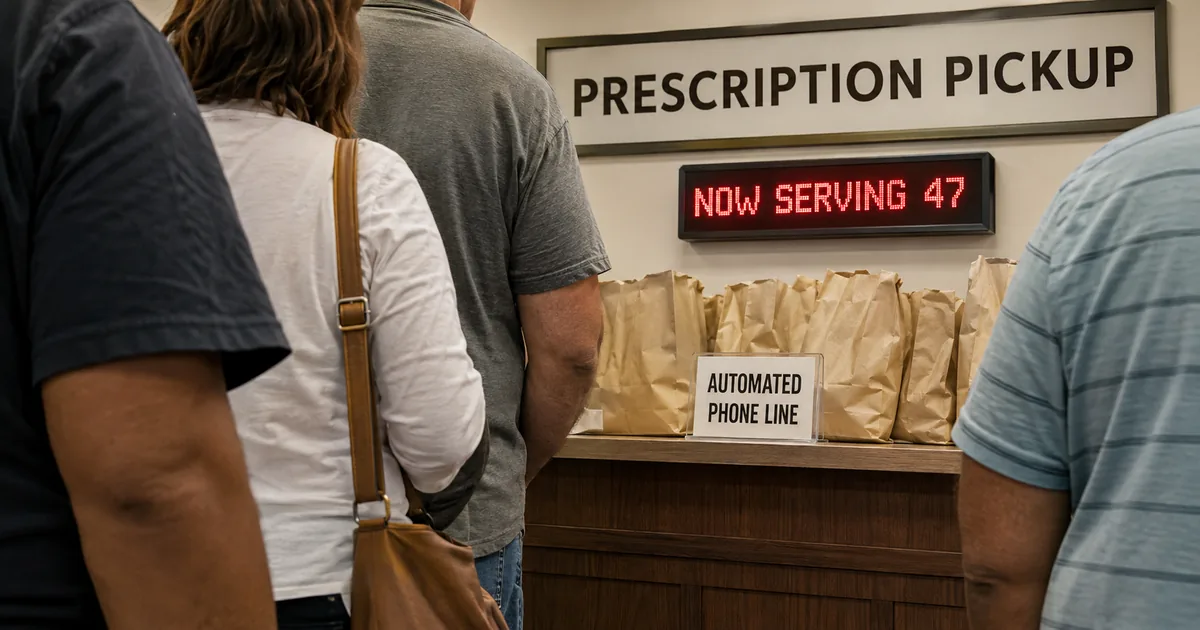
Earlier this summer, amid a nationwide wave of AI technology entering healthcare systems, Kinney Drugs implemented a new AI assistant for prescription refill services, lauding the tool as a way to improve communication and efficiency. But customers say it’s doing the opposite. / Kinney Drugs implemented the AI virtual assistant for patient communication and refill services in May. Soon after, its customers began to experience problems, they said. / According to nearly a dozen Kinney Drugs customers across its stores in Vermont and New York who spoke to VTDigger, the AI rollout has coincided with a range of problems. Delays have grown between physicians ordering drugs and the pharmacy processing them. The system has been unable to locate longtime customer accounts, has ordered incorrect dosages and has failed to notify customers when refills were ready for pickup. And these inaccuracies are raising privacy concerns amongst customers. / Their mounting frustrations toward the AI is leading some customers to leave the pharmacy entirely, they said, and forcing others to continue using a system they distrust due to a lack of pharmaceutical options in rural areas. — From the rollout timeline and the problems customers reported
A touch-tone phone line became a conversational AI
The change itself is concrete. Previously, refilling meant calling a prompt-based, touch-tone system and navigating a keypad to reach a pharmacist. Customers who spoke to VTDigger said that old system worked smoothly and gave them no problems.
The new system made that entrance conversational. The tool is named Burt, after the company's founder, and was built by Synerio, a Texas-based AI pharmaceutical company.
Customers point to the absence of any option to enter their request on a keypad. One customer who has worked in healthcare as an anesthesiologist noted that keypad entry had been standard in other phone interactions, and described the situation as talk to Burt or don't get your drugs.
The pharmacy's own terms carry a caveat: Burt may not be accurate, complete or up-to-date, and may be misleading or contain errors and omissions.
Previously, to refill a prescription at Kinney Drugs, a customer would call a prompt-based, touch-tone, phone system that would give them the opportunity to navigate a keypad to reach a pharmacist. Customers who spoke to VTDigger said this old system worked smoothly, and they had no problems. / The AI assistant, which Kinney Drugs named Burt, after its founder, was built by third-party AI pharmaceutical company, Synerio. / Synerio, the Texas-based technology company that supplies the AI tool to the pharmacy. / In the pharmacy's terms, Kinney Drugs states that “Burt may not be accurate, complete or up-to-date and may be misleading or contain errors and omissions.” / “Burt demands that you talk to him,” said Maria Aveni, a Vermont Kinney Drugs customer who has worked in healthcare as an anesthesiologist. “There’s no option to use a keypad to enter what you want to, which has been the case with other telephone interactions I’ve had. So it’s more of a talk to Burt or don’t get your drugs.” — From the contrast with the old system, the vendor behind the tool, and the absence of a keypad alternative
The company says it is aware of early friction
The company's response is reported too. A Kinney Drugs representative, who did not want to be identified by name, wrote to VTDigger that the company is aware some patients have experienced frustration with Burt, especially during rollout, and that it is reviewing each concern and attempting to reach each patient.
On why it deployed the tool, the answer is unambiguous: to eliminate repetitive tasks and free up time for its pharmacists.
A Kinney Drugs representative who did not want to be identified by name, wrote in a statement to VTDigger that the company is “aware that some patients have experienced frustration with Burt, especially during rollout,” and that it is reviewing each concern and attempting to reach each patient. / While customers said they were confused over why Kinney Drugs switched to the AI, the company cited a clear reason: to eliminate repetitive tasks and free up time for its pharmacists. — From the company's statement and its stated reason for deploying the tool
The company sees fewer calls. Did the load actually drop?
The most instructive part of this case is how the goal and the result diverged.
Leadership believes the goal is being met
The company's side believes the goal is being achieved. One director is quoted saying the AI is definitely doing the trick and handling those phone calls in such a nice manner that it's reducing the calls to the pharmacy.
Worth noting: no measured call volume appears in the reporting. What is presented is the company's read, not a verified figure. What can be read from it is that the metric the company was watching was the number of calls coming into the pharmacy.
Its leaders believe the AI has helped in achieving this goal, with one director saying that “it’s definitely doing the trick and handling those phone calls in such a nice manner that it’s reducing the calls to our pharmacy.” — From leadership's assessment that the deployment goal is being met
But questions at the counter went up
Customer experience, meanwhile, is described as producing an often opposite effect: as people hit problems with the AI, many turn to pharmacists for help.
In Vermont, pharmacists are described as already overburdened due to a chronic worker shortage. One customer said it is slowing down the productivity of an already stressed staff, adding that because that staff had cared for them for a long time and they feel loyalty, this is not just a financial concern but an inhumane way to treat the staff.
There is a structure here. What the company watched was call volume; what it wanted was pharmacist time. The former improved, in the company's read, while the latter may have moved the other way. Questions asked at the counter never show up in call statistics, so watching the metric alone makes it look like a success. Deciding, before deployment, which number would actually indicate the goal was met—skip that and the same divergence follows.
But customers' experience with the tool has led to an oftentimes opposite effect. As they encounter problems with the AI, many are turning to pharmacists more for help. In Vermont, pharmacists are already overburdened due to a chronic worker shortage. / “It’s slowing down productivity of an already stressed staff, and because that staff has treated me for a long time, and I feel loyalty, it isn’t just a financial concern for me, it’s an inhumane way to treat the staff,” Aveni said. — From the report that customers turn to pharmacists more, and the testimony about staff workload
Customers say there was no advance notice
Another point raised is communication before the rollout. According to multiple customers who spoke to VTDigger, Kinney Drugs did not communicate about the tool before implementation.
Some recalled signing onto a new refill system earlier in the summer; others did not realize the new tool existed until they called for a refill and heard the AI voice. The pattern suggests distrust came less from the deployment itself than from the point of contact changing without notice.
According to Aveni and other customers who spoke to VTDigger, Kinney Drugs did not communicate about the tool before implementation. / While some customers recalled signing onto a new refill system earlier this summer, others said they didn’t realize the company implemented the new tool until they called for a refill and heard the AI voice. — From the testimony that there was no communication before implementation
Questions about consent and data handling
Alongside the inaccuracies, the second half of the reporting deals with privacy.
Handing over a phone number counts as consent
The structure of the terms is at issue. Any customer who provides their telephone number automatically consents to interacting with the tool, with the option to opt out later.
The pharmacy's privacy policy, released the same month as the AI assistant, discloses for example that customers' protected health information may be used in AI tools to improve the pharmacy's operations.
Criticism of the consent framework itself is also covered. An associate professor of computer science at the University of Vermont noted that Kinney Drugs spreads its terms and conditions across 11 documents, and said that people absolutely do not understand what they are consenting to, so basing regulation on the idea of consent is not a realistic solution.
When terms and privacy policies are split across several documents, pulling them into one readable form before you review cuts down on what you miss.
Any customer who provides their telephone number to Kinney Drugs automatically consents to interacting with the tool, though they may later opt out, according to the pharmacy’s terms. / The pharmacy’s privacy policy, released the same month as the AI assistant, discloses, for example, that customers’ protected health information may be used in AI tools to improve the pharmacy’s operations. / Near, the UVM computer science professor, said that regulations like the new Vermont law are inherently flawed simply because they are based on consumer consent. Kinney Drugs, for instance, spreads its terms and conditions across 11 documents. / “I think that people absolutely do not understand what they’re consenting to, and so basing our regulation and what we think is okay on the idea of consent is not a realistic solution to these kinds of privacy concerns nowadays,” he said. — From the consent arrangement, the disclosure about health information, the 11 documents, and the critique of consent-based regulation
The list of parties to trust grows from one to two
The technical point is straightforward. A researcher at the University of Vermont said that privacy-wise the AI tool is worse than the previous refill system, because the vendor now also has access to customers' health data.
A professor of biomedical informatics at Vanderbilt University Medical Center framed it more generally: if you only interact with your healthcare provider, you rely on the security they have; once they start interacting with many other organizations, you have to worry about all the security issues with each of them.
The company's answer appears alongside. The representative said Kinney Drugs maintains multiple layers of security controls, invests in information security technologies to help protect sensitive data, and has protocols in place to respond to potential data breaches.
On US health privacy law, as long as there is a business associate agreement—the HIPAA contract establishing that third-party vendors securely handle protected health information—the companies are contractually obliged to handle data securely. The representative declined to share the agreement, citing an inability to disclose private vendor contracts, but wrote that the company maintains the appropriate agreements. Synerio did not respond to requests for comment, though its own pages say its tools are built to be HIPAA compliant.
Joseph Near, an associate professor of computer science at the University of Vermont, said that, privacy-wise, the AI tool is worse than the pharmacy’s previous refill system because this additional company, Synerio, now also has access to customers’ health data. / “If I just interact with my healthcare provider, I’m relying on the security that they have. If they now start interacting with many other organizations, I now have to start worrying about all the security issues with each of them,” Bradley Malin, a professor of biomedical informatics at Vanderbilt University Medical Center, said, referring to Synerio. / The Kinney Drugs representative said that the company maintains “multiple layers of security controls,” invests in “information security technologies to help protect sensitive data” and has the protocols in place to respond to potential data breaches. / However, as long as the pharmacy has a business associate agreement — the contract under HIPAA that establishes that third-party vendors securely handle protected health information — the companies are contractually obliged to handle data securely. The Kinney Drugs representative declined to share the agreement, citing an inability to disclose private vendor contracts, but wrote that the company “maintains the appropriate agreements.” / Synerio did not respond to multiple requests for comment, but also says on its webpages that the tools it creates are built to be compliant with HIPAA. — From the widened data exposure via the AI vendor, the company's security response, and the HIPAA business associate agreement
Regulation is described as lagging
The legal side comes up as well. Several lawyers told VTDigger that the technology is outpacing regulation, leaving consumer protections thin.
In Vermont, a new data privacy bill, S.71, was signed on June 16, 2026, but takes effect in two years. Privacy advocates say the gap compounds a bill they already consider too weak. A Vermont lawyer who testified on the bill said that even if it were in effect, he is not sure it would necessarily cover the situation.
The risk of relying on third-party AI shows up in industry filings too. McKesson, which runs Kinney Drugs' pharmacy management system, wrote in public filings that reliance on third-party AI tools and solutions may expose it to risks outside its control, including compliance gaps.
As AI pops up in healthcare systems across the country, several lawyers told VTDigger that the technology is outpacing regulation, leaving consumer protections thin. / In Vermont, a new data privacy bill, S.71, signed by Gov. Phil Scott on June 16, takes effect in two years. That delay creates a gap in compliance to a bill that privacy advocates say is already too weak to protect consumers. / “Even if it were in effect, I’m not sure that it would necessarily cover the situation,” said Ryan Kriger, a Vermont lawyer and resident who testified on the bill. / While Synerio did not respond to VTDigger’s questions about customer protections, Kinney Drugs’ pharmacy management system, McKesson, acknowledged them in public filings, writing that “reliance on third-party AI tools and solutions may expose us to risks that are outside of our control, including compliance gaps.” — From the observation that regulation lags the technology, and the disclosure about third-party AI risk
Summary: decide these before putting AI at the front door
Reading this as "AI doesn't work" gets you nothing. What the reporting actually offers is three things that could have been decided during design.
First, how you pick the metric. The goal was freeing pharmacist time; what dropped was call count. Without a number that measures the goal itself, only the proxy improves and it looks like success.
Second, keeping an escape route. Had the keypad path remained, people the AI could not understand would still have gotten back to the old baseline. Adding a new path and replacing the existing one are different decisions.
Third, telling people in advance. Testimony that there was no communication before the rollout is a large part of the distrust. The same feature lands differently depending on whether people were told.
Regulators are moving too. Colorado's AI Act pushes transparency and disclosure obligations onto operators. Before the capability of a tool comes the question of where to put it, what to measure, and how to announce it. This reporting shows concretely what happens when that order gets reversed.