What NVIDIA secured at PORTS-Pike
The striking part of the announcement is a chip company moving on land and electricity rather than silicon.
Initial 4.25 IT-GW with an option on 3.75 more
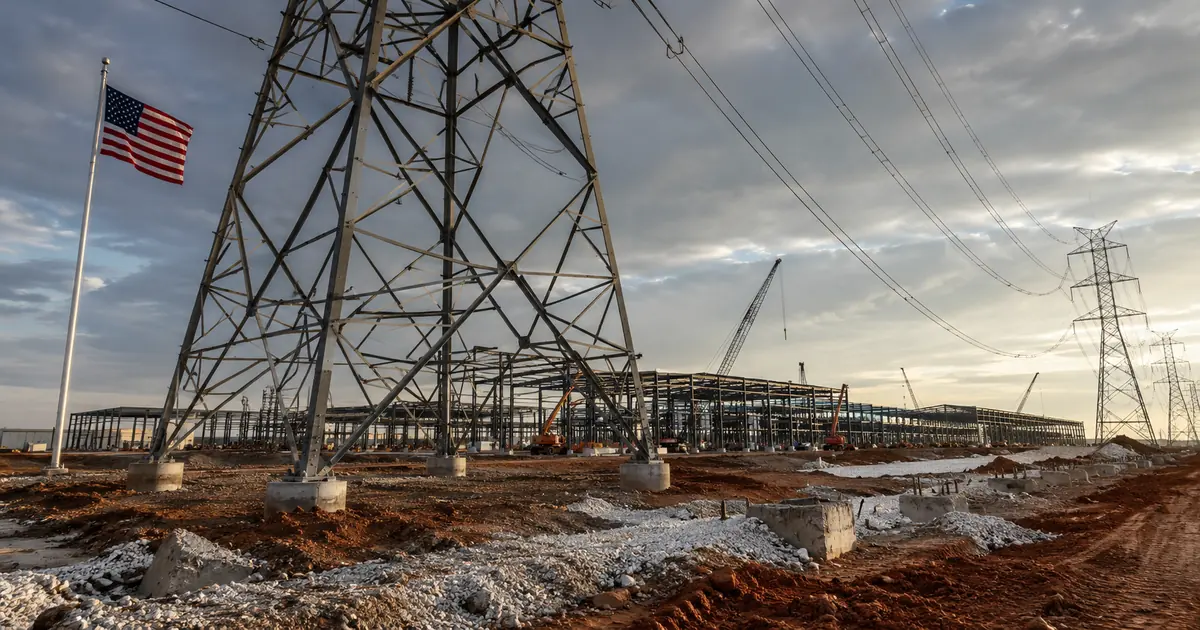
NVIDIA locked up land, power, and shell — LPS — at PORTS-Pike through a partnership with SB Energy. NVIDIA's release frames the campus as one that exclusively hosts its AI compute. The initial deployment is sized for 4.25 IT-GW of capacity, and NVIDIA holds an option on the remaining 3.75, which totals 8 IT-GW. IT-GW counts capacity by the power the data center's IT equipment draws, which is a different measure from generation-side gigawatts. What goes inside is NVIDIA's full-stack DSX AI factory platform: GPUs, CPUs, and networking as one specified configuration.
Credit is what makes the reservation possible. NVIDIA's release says only that it provides credit support on the land, power, and shell buildout, without naming a figure. UPI reported financing of up to $105 billion. That number is not in the official release, so it belongs to the reporting rather than to NVIDIA.
"NVIDIA to provide credit support on land, power and shell buildout to secure initial 4.25 IT-GW, with an option to take the remaining 3.75 IT-GW." (news summary)/"OpenAI will be the customer for 8-IT GW." (news summary)/"The AI factory will use NVIDIA’s full-stack DSX AI factory platform, including GPUs, CPUs and networking. The initial deployment is designed to support 4.25 IT-GW of AI factory capacity." (body)— from NVIDIA's press release
"Nvidia announced on Monday that it will finance an OpenAI data center in Ohio for up to $105 billion." (the reported figure)/"The credit from Nvidia will fund the data center's first 4.25 gigawatts in computing capacity with an option to bring 3.75 gigawatts more online." (what the credit covers)— from UPI
NVIDIA is investing $1.5 billion in SB Energy
Separately from the credit support, NVIDIA is investing $1.5 billion in SB Energy, joining existing investors SoftBank Group and OpenAI. That puts NVIDIA inside the developer building the infrastructure it will fill, not just alongside it.
"NVIDIA will invest $1.5 billion in SB Energy, joining existing investors SoftBank Group and OpenAI. The investment supports SB Energy’s continued evolution into a leading AI infrastructure developer, while supporting Pike County and other local communities, with the vast opportunity ahead to deliver compute infrastructure at speed and scale."— from NVIDIA's press release
What OpenAI leases and when it starts
OpenAI published its own announcement the same day, from the tenant's side of the deal.
The 20-year lease covers about 8 gigawatts-IT
OpenAI has an agreement to secure approximately 8 gigawatts-IT at PORTS-Pike, leasing a facility SB Energy builds, owns, and operates for 20 years. The 20-year term is how far ahead the compute capacity is being committed. The site reindustrializes the decommissioned Portsmouth Gaseous Diffusion Plant and the land around it, spanning private and federal ground, developed with AEP Ohio, the U.S. Department of Energy, and the U.S. Department of Commerce.
"OpenAI has entered into an agreement to secure approximately 8 gigawatts-IT at the PORTS-Pike Technology Campus in Pike County, Ohio, working with SB Energy, NVIDIA, and the U.S. Department of Energy."— from OpenAI's announcement
"SB Energy will build, own and operate the data center under a 20-year lease to OpenAI." (lease terms)/"SB Energy’s PORTS-Pike Technology Campus is reindustrializing the decommissioned Portsmouth Gaseous Diffusion Plant and the surrounding area, bringing a new generation of jobs to Appalachian Ohio…" (the site)/"Spanning private and federal land, the campus is being developed in collaboration with AEP Ohio, the U.S. Department of Energy and the U.S. Department of Commerce." (development partners)— from NVIDIA's press release
Capacity comes online in phases from 2028
None of this switches on at once. The planned capacity is expected to come online in phases beginning in 2028, which puts the full 8 IT-GW well past the announcement year.
"The planned capacity is expected to come online in phases beginning in 2028."— from NVIDIA's press release
What the project promises Ohio
At this scale, electricity, water, and jobs become the terms the county actually negotiates over.
SB Energy pays for the grid upgrades, not ratepayers
This is the commitment stated most plainly. SB Energy is to pay the full cost of the grid upgrades and new transmission lines needed to serve the data center, and OpenAI writes that those costs will not be shifted to Ohio or other ratepayers in the region. On the generation side, SB Energy and SoftBank will build at least 10 gigawatts of new energy generation, which is what yields the 8 IT-GW of AI factory capacity, and will invest at least $4.2 billion in regional grid infrastructure through a partnership with AEP Ohio that NVIDIA describes as designed to protect ratepayers.
"SB Energy will pay the full cost of the grid upgrades and new transmission lines needed to serve the data center. Those costs will not be shifted to Ohio or other ratepayers in the region."— from OpenAI's announcement
"In support of the surrounding Ohio community, SB Energy and SoftBank will build at least 10 gigawatts of new energy generation, which results in 8 IT-GW of AI factory capacity, and invest at least $4.2 billion in new regional grid infrastructure through an innovative partnership with AEP Ohio designed to protect ratepayers."— from NVIDIA's press release
35,000 construction jobs are projected through 2032
Employment is projected at 35,000 construction jobs across the six-year buildout through 2032, plus 2,500 long-term operating roles. On community money, OpenAI is matching SB Energy's previously announced $40 million grant fund with another $40 million, for $80 million total, allocated against priorities local residents name — schools, public safety, health care, workforce training, housing among them. OpenAI is separately making up to $84 million in Codex credits available through ChatGPT — $100 each for approximately 844,000 eligible Ohio college, community college, and technical school students aged 18 and older during the 2026–2027 academic year.
"The project is expected to create 35,000 construction jobs during its six-year buildout through 2032 and 2,500 long-term operating jobs." (jobs)/"We will also invest $40 million in a community grant fund supporting priorities identified by local residents—building on SB Energy’s previously announced $40 million commitment. Separately, we are providing $84 million in Codex credits through ChatGPT, giving every Ohio college student access to the technology." (community fund and credits)/"Building on SB Energy’s existing $40 million community agreement, OpenAI will invest an additional $40 million, and this community investment will be shaped by local residents’ priorities such as schools, public safety, health care, utilities, workforce training, housing, veterans’ services, small businesses, and support for working families." (how the fund is directed)— from OpenAI's announcement
The first 800 MW land in 2028 on AEP infrastructure
Not all of the capacity needs new generation to arrive. The first 800 megawatts are expected to become available in 2028 largely using existing AEP infrastructure. Everything past that is what requires new power plants connected to the grid — natural gas generation among them — plus new transmission lines and the associated build. For anyone in the region reading the 8 IT-GW headline, that split is the part that says when new plants actually get built.
"The first 800 megawatts are expected to become available in 2028 largely using existing AEP infrastructure. Further development will require new power plants connected to the grid, including natural gas generation, as well as new transmission lines and associated infrastructure."— from OpenAI's announcement
Cooling recirculates water instead of consuming it
Water consumption has been the flashpoint at data center sites elsewhere. Here the design is closed-loop, air-cooled systems that recirculate water rather than cooling towers that consume it continuously. Once the system is filled, ongoing use is expected to be comparable to an office building supporting a similar number of people. OpenAI says it will publicly report the project's expected water use once the site design is finalized.
"The data center will use closed-loop, air-cooled cooling systems that recirculate water rather than relying on cooling towers that continuously consume water for cooling." (cooling design)/"Once the data center cooling system is filled, ongoing water use is expected to be comparable to an office building supporting a similar number of people, including sinks and restrooms, equipment washdown and maintenance, and landscaping." (expected usage)/"Once the site design is finalized, we will publicly report the project’s expected water use." (disclosure commitment)— from OpenAI's announcement
NVIDIA's release, OpenAI's announcement, and the UPI report describe one project from three angles, and the figures sit in different documents. Converting all three to Markdown makes it possible to line up which number came from which source.
Summary
PORTS-Pike splits one large AI site across three parties: NVIDIA secures the land, power, and shell and backs it with credit, SB Energy builds and runs it, and OpenAI leases it for 20 years. The scale is roughly 8 gigawatts-IT, phasing in from 2028. The $105 billion headline figure appears nowhere in NVIDIA's release — it was reported as the ceiling on the credit facility. For Ohio, the stated terms are no pass-through of transmission costs, closed-loop cooling, and $80 million in combined community funding. OpenAI's push to lock down compute also runs through its own silicon, which we cover in our piece on the Jalapeño inference chip.