What Is OpenAI Jalapeño?
How Jalapeño's development is divided
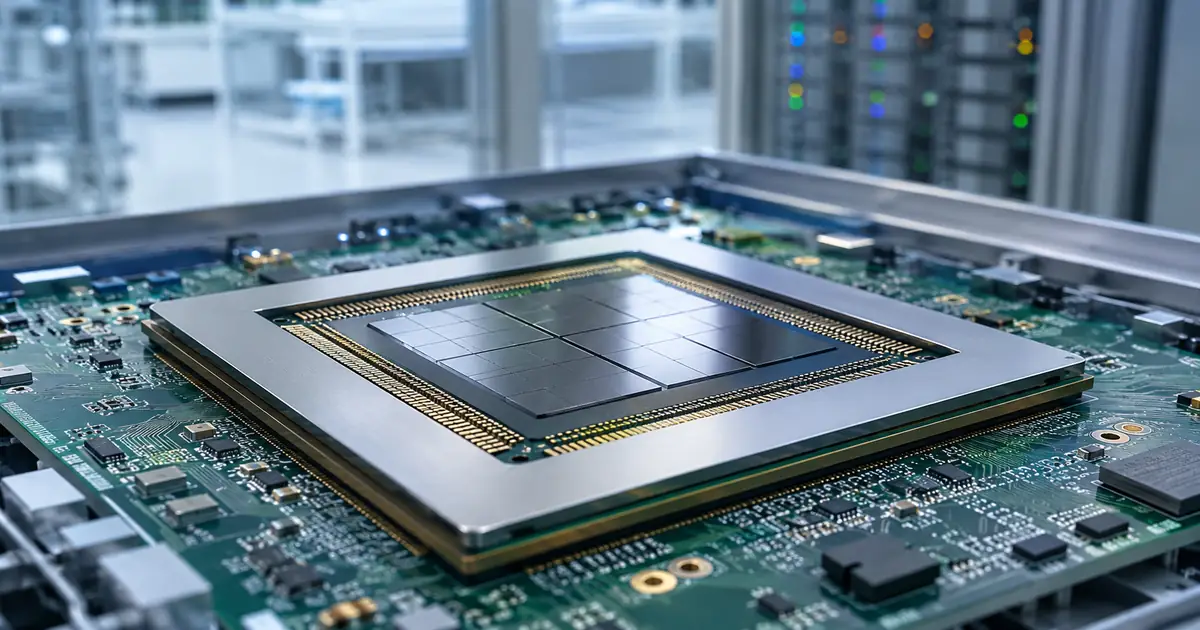
OpenAI Jalapeño is the first in-house AI chip from OpenAI, co-developed with semiconductor giant Broadcom. Announced on June 24, 2026, it was delivered to OpenAI CEO Sam Altman and President Greg Brockman by Broadcom's Hock Tan and Charlie Kawwas. It marks a turning point in vertical integration — OpenAI moving to own the very foundation that runs its inference.
"OpenAI and Broadcom (NASDAQ: AVGO) today unveiled Jalapeño, OpenAI's first Intelligence Processor: an accelerator architected around OpenAI's vision for the future of LLM inference." — from the Jalapeño announcement
Jalapeño's definition (OpenAI's first "Intelligence Processor")
Jalapeño is what OpenAI calls an "Intelligence Processor" — its own term for a self-designed accelerator (a compute chip specialized for AI). It was designed from a blank slate for modern LLM inference, not a general-purpose part adapted after the fact, a point OpenAI stresses throughout the announcement.
"Jalapeño is a blank-slate design for modern LLM inference, not a general-purpose accelerator adapted from earlier AI workloads." — from the Jalapeño announcement
What "inference-only" means (vs. training)
It helps to clarify "inference" first. AI work splits into two stages: "training," which builds a model from vast data, and "inference," which runs the finished model to produce answers. Jalapeño targets the latter — the moment ChatGPT answers a question. Inference is where AI reaches people, so making it faster, cheaper, and more stable feeds directly into how good the service feels.
Engineering samples are already running in the lab at production target frequency and power, executing AI workloads that include OpenAI's GPT-5.3-Codex-Spark.
"Engineering samples of the Jalapeño chip are running ML workloads in the lab at production target frequency and power, including GPT-5.3-Codex-Spark." — from the Jalapeño announcement
How OpenAI, Broadcom, and Celestica divide the work
As the figure above shows, OpenAI designs the chip, Broadcom handles silicon implementation, high-speed networking (Tomahawk), and production, and Celestica handles board, rack, and system integration. OpenAI pours its model insights into the design, and the semiconductor and networking specialists turn that into an industrial product.
Compared with a general-purpose high-performance accelerator, Jalapeño sits like this.
| Aspect | Conventional general-purpose accelerator | Jalapeño (inference-only) |
|---|---|---|
| Design philosophy | Broad: training and inference alike | Blank-slate design focused on LLM inference |
| Optimization target | General compute performance | Kernels, memory movement, networking, serving |
| Who leads the design | Chip vendor | OpenAI, guided by its model insights |
| Main goal | Broad supply to the whole market | Running OpenAI's own inference efficiently |
Performance and the Nine-Month Build
Key facts about Jalapeño
What draws attention is not only the novelty of the goal, but the projected performance and the build speed. Here is what has been disclosed.
Performance per watt: "substantially better" (measurement in progress)
In early testing, OpenAI says Jalapeño's performance per watt is on track to substantially exceed the current state of the art. That said, final measurement is still in progress, and the detailed technical report is due in the coming months. Since the numbers aren't final, they are best read as projections.
"While OpenAI is still measuring final performance, early testing shows that Jalapeño will deliver performance per watt substantially better than current state-of-the-art." — from the Jalapeño announcement
The basis for the performance is the architecture. By cutting down on data movement and balancing compute, memory, and networking, it is designed to reach realized performance close to the theoretical peak.
"The architecture reduces data movement and balances compute, memory, and networking resources to achieve realized utilization much closer to theoretical peak performance." — from the Jalapeño announcement
From design to tape-out in "just nine months"
The build speed stands out too. From the initial design to the manufacturing milestone, tape-out, took just nine months. OpenAI calls it what it believes to be the fastest ASIC development cycle ever achieved in high-performance advanced semiconductors. This kind of chip development usually takes years, which makes nine months strikingly fast.
"Jalapeño was co-developed from initial design to manufacturing tape-out in just nine months, and the custom AI accelerator program represents what we believe to be the fastest ASIC development cycle ever achieved in high-performance advanced semiconductors." — from the Jalapeño announcement
OpenAI's own AI models sped up the design
That speed was helped by OpenAI's own AI models. On top of tight software-hardware co-development, the company used its own models for parts of the design and optimization. The same models served to users are helping build the foundation that will run the next generation — a self-reinforcing loop.
"The same models served to users are helping improve the infrastructure used to run future models." — from the Jalapeño announcement
Faster, cheaper inference flows straight back into how services like ChatGPT feel. For the differences between the major models and the bigger picture, see our guide to ChatGPT (GPT-5).
Why OpenAI Is Building Its Own Chip
What OpenAI now designs in-house (the full stack)
Jalapeño's real significance lies less in one chip's performance and more in how far OpenAI wants to own its own stack. Here are three angles on the backdrop.
A "full-stack" strategy: designing everything from chip to product
OpenAI has built frontier models and the products on top of them. Now it is stepping into the layer below — the chips and networking that run those models. The strength of vertical integration is that every layer can be optimized toward one goal: making the models faster, more reliable, and more affordable. President Greg Brockman frames Jalapeño as part of that long-term full-stack strategy.
"Jalapeño is part of our long-term full-stack infrastructure strategy to make compute more abundant, resulting in AI which is faster, more reliable, more affordable for people and businesses." — from the Jalapeño announcement
The "first-generation chip" of the ten-gigawatt partnership
Jalapeño didn't come out of nowhere. Back in October 2025, OpenAI and Broadcom had already announced a partnership to co-deploy ten gigawatts of OpenAI-designed custom AI accelerators, and Jalapeño is the first generation of that multi-generation plan.
"Broadcom will deploy racks of AI accelerator and network systems targeted to start in the second half of 2026, to complete by end of 2029." — from the strategic-collaboration announcement
The view that it reduces Nvidia reliance
Moves like this are often described as a way to reduce reliance on Nvidia's GPUs. Serving its own inference on its own chip does loosen concentration on any single vendor. That said, OpenAI's official materials never claim to "replace Nvidia." What it puts forward is the full-stack story of making compute more abundant and AI more broadly available; the "reduced Nvidia reliance" reading comes from outside observers.
When Jalapeño Ships and What It Means
The OpenAI × Broadcom timeline
Finally, here is when Jalapeño starts running and how it touches everyday AI users.
Deploying from the end of 2026 with Microsoft and others
As the first step of a multi-generation platform, Jalapeño is slated for initial deployment from the end of 2026. Broadcom CEO Hock Tan says that co-developing the silicon directly with OpenAI enables gigawatt-scale data centers with Microsoft and other partners beginning in 2026.
"By co-developing our industry-leading silicon directly with OpenAI, we are enabling the deployment of gigawatt scale data centers with Microsoft and other partners beginning in 2026." — from the Jalapeño announcement
What it means for everyday AI users
Jalapeño isn't something individuals buy and use directly. Even so, the benefits circle back into everyday AI. If inference gets cheaper and faster, that shows up as quicker ChatGPT answers, more stable access at peak times, and cheaper-to-build API products. OpenAI itself stresses that inference is where AI reaches people, and that each improvement there changes how the experience feels.
Official announcements like this are often long English texts, and there are times you'll want AI to summarize the key points. Converting a web page into clean Markdown keeps the heading and table structure intact, which tends to improve how accurately AI reads it.
The Bottom Line on OpenAI Jalapeño
OpenAI Jalapeño is the company's first in-house AI chip, built with Broadcom. It is purpose-built from scratch for inference — running trained models — and its performance per watt is projected to substantially beat the current state of the art. It was finished at an unusual pace, from design to its manufacturing milestone in nine months. Behind it sits a full-stack strategy of owning everything from chip to product, plus the ten-gigawatt partnership struck in October 2025. OpenAI doesn't claim to "replace Nvidia" — but the move to serve its own inference on its own chip is clearly accelerating.
For more on the latest models and availability, see our explainers on why you can't use GPT-5.6 yet and OpenAI Daybreak.