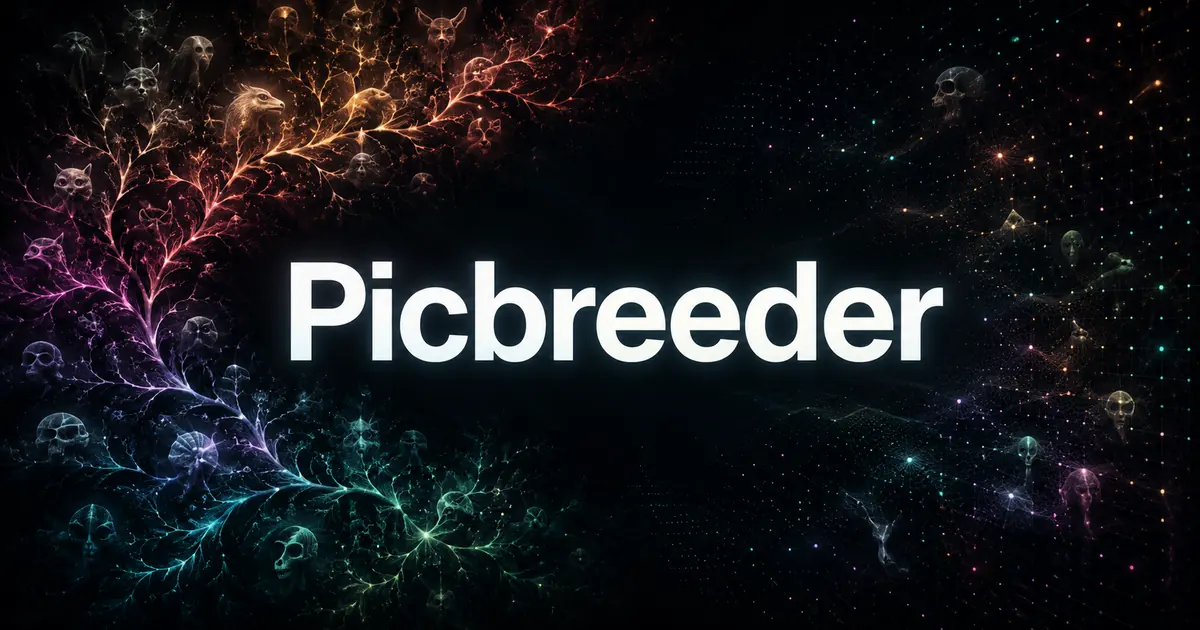
What Picbreeder Is (Background)
Key terms in this research
First, let us establish what the experiment set out to recreate. The key is "Picbreeder," a rather unusual image-evolution experiment.
The Picbreeder Experiment (Evolving Images With No Goal)
Picbreeder was a now-lost website where people collaboratively evolved images. There was no predetermined goal; users simply selected the images they found interesting. As many people repeated that selection over many generations, unexpected forms such as faces, animals, vehicles, and skulls emerged naturally.
"Users simply selected images they found interesting, allowing unexpected forms such as faces, animals, vehicles, and skulls to emerge gradually across many generations and many different people." — from the description of the experiment
"The Myth of the Objective" and Open-Endedness (The Motive)
This experiment was also central to the book Why Greatness Cannot Be Planned by Professor Kenneth Stanley and colleagues. It has been told as an example of a paradox: that fixing a clear objective can actually push great discoveries further away. Exploration that sets no goal in advance is called "open-ended," and this is thought to be at the very root of human creativity. So, can AI recreate that open-ended exploration? That is the starting point of this research.
How Sakana AI Recreated It
The loop the VLM agents repeat
Next, let us look at how Sakana AI recreated this "goal-free evolution" with AI. Standing in for humans were the agents of a vision-language model (VLM).
How the VLM Agents Recreate It
Sakana AI, in joint research with MIT and NYU titled "In Search of the Ingredients of Open-Endedness," rebuilt the Picbreeder process using VLM agents. The agents explore a shared archive, choose images to branch from, evolve new candidates, publish their favorites, and evaluate other agents' creations. AI carries out this whole flow in place of a human crowd.
"The agents explore a shared archive, choose images to branch from, evolve new candidates, publish their favorites, and evaluate the creations of other agents. There is no target image and no explicit definition of what counts as progress." — from the recreation method
A Design With No Goal and No Definition of Progress
What is especially important here is that the agents are given neither a "correct image" nor a definition of "what counts as progress." Ordinary AI optimizes toward a correct answer or goal. Here, that goal is deliberately removed, creating conditions close to the human Picbreeder—where you simply keep selecting what you find interesting. This design makes it possible to test whether AI can truly perform open-ended exploration.
The Promise and Limits the Experiment Revealed
Humans vs. VLM agents
The recreation revealed both the "promise" and the "limits" of AI-driven open-ended discovery. Let us take them in turn.
AI Circles Back to the Same Ideas / Diverse Personalities Help
First, the limits. Compared with humans, VLM agents kept returning to the same kinds of images and ideas. They chose similar images as parents, made small conceptual leaps, and leaned toward polishing ideas at hand rather than boldly discarding them.
"Compared with humans, VLM agents tend to keep circling back to the same kinds of images and concepts." — on the limits
But the promise showed clearly too. When the agents were given diverse "personalities" and formed a population, exploration improved greatly, and the semantic breadth of the archive they produced approached what humans made.
"However, introducing a diverse population of agent personalities substantially improves exploration. In some runs, diverse agent populations approached or matched the human archive on measures of semantic diversity and produced more balanced evolutionary trees." — on the effect of a diverse population
Open-Ended Evolution Yields More Robust Representations
There was another intriguing finding: goal-free evolution may yield internal representations that are harder to break (more robust). A skull image the agents evolved changes smoothly when its internal values are perturbed, and is less fragile than one made directly with gradient descent (a common optimization that reduces error). That said, it was not as cleanly organized as one humans evolved collectively.
"A skull evolved by the agents changes smoothly when its underlying neural representation is perturbed, less fractured than a skull directly optimized with gradient descent, although still less cleanly disentangled than one evolved collectively by humans." — on robust representations
The Remaining Gap in Creativity, and What It Suggests
The gap not yet closed
And the most intriguing part of this research is the result itself—that "a gap remained." Even as it showed promise, AI did not fully reach human creativity.
Humans Turn Accidents Into Sustained Discovery
Humans are good at turning something that happened by chance into sustained creation. When they find something unexpected, they sense its value, chase it, and generate a larger leap from it. The AI agents can notice interesting patterns too, but a clear gap emerged: they are prone to becoming trapped in them.
"Humans appear better at turning fortunate accidents into sustained creative discoveries ... The AI agents often notice interesting patterns too, but are more likely to become trapped in them." — on the remaining gap
The "Ingredient" AI Is Missing (Looking Ahead)
Why can humans pursue such open-ended exploration? What does today's AI lack? Sakana AI frankly says this is not yet fully understood. Human creativity still holds something important that today's AI has not yet learned—that is the conclusion for now. Sakana AI frames this question as a broad theme that also connects to the AI-driven scientific research the company pursues. For more on the breadth of its work, see also Sakana AI's benchmark research.
When working through English-language papers or blogs, converting a page to Markdown keeps the structure of headings and figures intact, making the key points easier to follow. To reformat a web page as-is, the following tool is handy.