What Happened
How it unfolded
It started two months after he left, when he happened to look at his old employer's site. The dates come from his own account and from the reporting.
"Touati's contract with the organisation began in January 2024, when ClickOut Media was still known as Finixio." / "“Every one falls after 9 March, the day Clickout revoked my access, and from 23 March I wasn't even employed. Whenever they were first written, every change happened while I was locked out.”" / "The articles all have last-updated dates between 15 May and 14 July 2026. The site appears to have reappeared online on 14 July." — Press Gazette
Articles Kept Appearing Under His Name
Press Gazette reported the case of Ben Touati, a freelance writer for the publishing and SEO company Clickout Media. After he was made redundant, AI-written articles he had nothing to do with continued to be published under his byline.
"A freelance writer who worked for publishing and SEO company Clickout Media has revealed how AI-written articles continued to appear under his name after he was made redundant." — Press Gazette
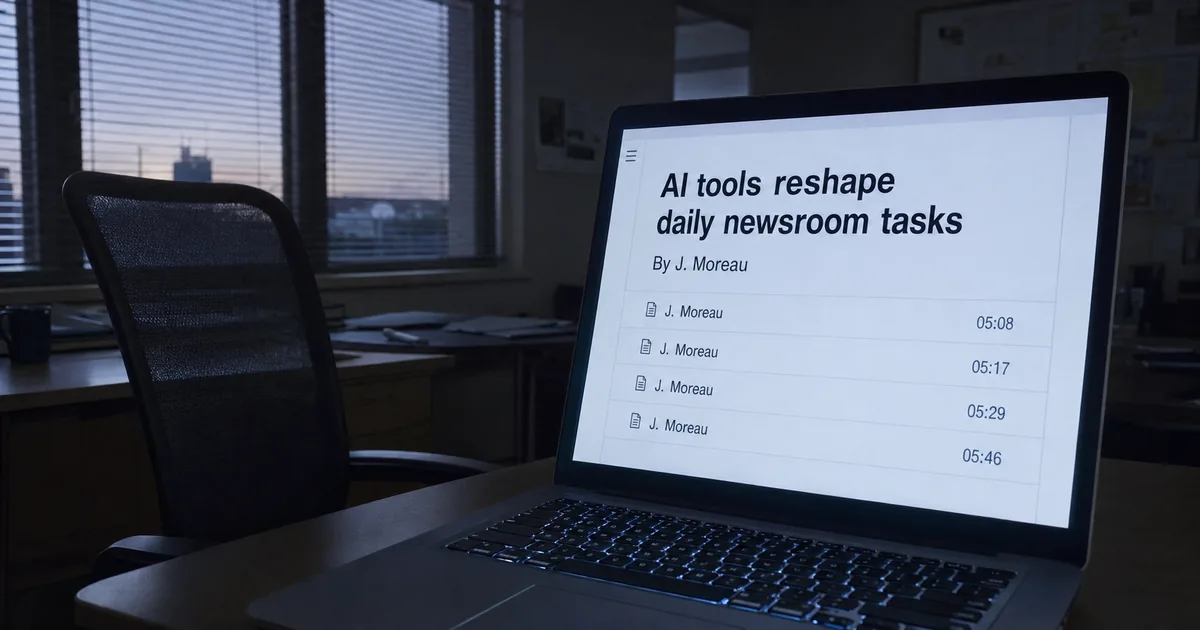
He found them on 26 May 2026, and the giveaway was the timestamp. All five had been published before working hours, between roughly 5:39am and some time after 6am, day after day.
"“They were all published before working hours, so times ranged from like 5:39am to six something am, and it happened day after day after day, and then they stopped on the 29th of May.”" — Ben Touati, quoted by Press Gazette
The articles also carried technical traces of machine generation, he said, including odd tags with the hallmarks of AI. He described the experience as a real slap in the face and said it left him feeling exploited.
"He said that “technical fingerprints” on the articles showed him they had all been written by AI – including strange tags that bore the hallmarks of AI." / "He said: “It was a real slap in the face.”" / "He said the experience left him feeling “exploited.”" — Press Gazette
The GDPR Claim, and What Followed
On 2 June 2026, Touati filed a claim under the GDPR (the EU regulation governing how personal data is handled), arguing that his personal information had been misused. The byline came off, but the articles were not removed. They went back up under a different writer's name.
"Touati filed a GDPR claim against Clickout on the second of June for misuse of his personal information and they removed the byline for those articles which then reappeared under another writer." — Press Gazette
That was not the end of it. In a 16 July update, Press Gazette reported that after its story ran, the company's German site came back online, with 28 new casino-related articles published under Touati's byline. He says every one of those changes happened after he had been locked out.
"In the wake of Press Gazette's reporting of the issue, Clickout Media appears to have resurrected their German Esports Insider site with 28 new articles now appearing under Ben Touati's byline." — Press Gazette update, 16 July 2026
What the Company Said
Clickout Media told Press Gazette that it uses AI-assisted content where appropriate, combined with human checks and edits, and that it keeps working to make its AI agents more accurate and its human editorial processes better.
"Clickout Media said in an email: “We use AI-assisted content where appropriate in tandem with human checks and edits. We continue to evolve our AI agents to be more accurate and improve our human editorial processes.”" — Press Gazette
The statement says nothing about bylines specifically. How the company views this particular case is not something the response makes clear.
Why This Keeps Happening
The structure behind byline misuse
Filed away as one company's misconduct, this repeats somewhere else. The ground it grows on is worth looking at directly.
Borrowing an Existing Site's Credibility
Press Gazette describes the company as a practitioner of parasite SEO, the tactic of using an established site's authority to push articles on topics that site was never about into the search results. Google treats this as a violation, and Techopedia, the site Touati first wrote for, was delisted from Google over it.
"But the site Techopedia got delisted from Google (Google penalises sites for so-called 'parasite SEO' where they use the authority of an existing site to boost articles on another topic, which in Clickout's case is almost always casino articles)." / "the site was penalised by Google in late 2024 for parasite SEO, recovered, but was then penalised again in December, at which point Clickout abandoned it, making many staff redundant" — Press Gazette
Press Gazette characterises the firm as one that buys publications, often for large sums, replaces journalists with AI, and earns money through casino links. The point of the articles is not the articles. It is the traffic they collect and where that traffic is sent.
"the SEO firm (which buys publications, often for large sums, before replacing journalists with AI in order to earn money through casino links)" — Press Gazette
Writers Being Displaced by AI
According to Touati, writers at the sites were pushed repeatedly to use AI. Managers told them it was almost impossible to get by without AI these days, he says.
"Touati said that managers constantly encouraged writers at the sites to use AI to write articles, with managers saying: “It's almost impossible to get by without AI these days.”" — Press Gazette
He used AI for research but not for the finished copy. In early 2026 he was told that several other freelancers had been let go because there was not enough work and everyone had scaled up their productivity with AI. His own dismissal was given a different reason: Esports Insider had been de-indexed by Google, and The Escapist barely made money.
"In early 2026, managers told Touati that they had let multiple freelances go because there was not enough work and everyone had “upscaled” their productivity with AI." / "A manager wrote to him saying that because Esports Insider had been de-indexed by Google and The Escapist barely made money, so he would have to let him go." — Press Gazette
The person was replaced by AI, and then the person's name stayed behind and kept working. That is the shape of this story.
Bylines Are Targeted Because They Signal Trust
Why use a name at all? Because the byline functions as a marker of credibility. An article with a real writer's name attached lands better with readers and with search engines than one from nobody in particular.
Which makes unauthorised byline use a way of borrowing, without consent, the credibility a writer spent years building. The damage is not limited to seeing your name somewhere you did not agree to. A writer known for gaming and esports ends up attached to casino content. The expertise itself gets rewritten in a direction the writer never chose.
Protecting a Byline and the Trust Behind It
What each side can do
Articles keep going live while the rules catch up. What is available right now depends on where you stand.
| Position | What to check | What to do when you find something |
|---|---|---|
| Writer | Your author page, on a schedule, after the contract ends | Save the URL, timestamp, and screenshots; raise it as a personal data matter |
| Reader | Clustered publishing times, mismatch with the writer's field, presence of sources | Do not rely on an article whose sources cannot be traced |
| Publisher | Whether the byline matches whoever is actually accountable | Show AI involvement and the human reviewer as separate things |
What Writers Can Check and Do
The practical move is simple: keep looking at your own author page after the contract is over. In this case it surfaced only because he happened to check two months later. Without that visit, nothing would have come to light.
If you find something, save the article URL, the publishing timestamp, and screenshots. A person's name counts as personal data, so the data protection route used here is available. It is worth knowing the limit of that route as well: the byline came off, and the article stayed up under someone else's.
What Readers Can Look For
Readers have signals too, and the one that cracked this case is a good starting point. Are publishing times oddly clustered in the early morning? Is the same byline producing articles nearly every day? Does the subject match what that writer actually covers? None of those checks requires specialist knowledge.
Whether sources are cited concretely matters as well. An article that gives numbers and specifications with no link back to a primary source deserves caution regardless of whose name is on it. If you want to examine wording and length patterns for mechanical tells, see character count and SEO. For how search intent and keywords are handled, see related keywords and SEO.
Detection work is progressing in video as well. See NVIDIA's synthetic video detection model.
What Publishers Owe Readers
What publishers need to show is the split between AI involvement and human accountability. Using AI is not the problem. Readers being unable to see who is answerable for the content is.
In practice: name the person who gave the article its final check, and make that person's background and expertise verifiable. Put the byline only on someone who actually carries responsibility. With those two in place, what happened here does not work. sakutto.ai uses AI in its writing process, and every published article is verified by the operator against primary sources, with the reviewer's name and background stated. Putting a name on an article means answering for it.
Conclusion
What this case exposes is not that AI can write articles. It is that a real person's name can be attached to what AI wrote. The byline has worked as a token of trust, and that token can now be detached and reused on its own.
Writers should build the habit of checking where their name is being used after a contract ends. Readers should stop treating the presence of a byline as trust and look at timestamps and sourcing. Publishers should present AI involvement and human accountability separately. Without all three, the same thing happens somewhere else.
Checking a story often means going to an English-language primary source. A tool that turns a web page into something readable lowers the cost of that check.