What Apple and Micron Are Fighting Over
The shape of the dispute
The dispute turns on where a product using Chinese memory may be sold. The two positions do not meet.
| Aspect | Apple's position | Micron's position |
|---|---|---|
| What is sought | Permission to use Chinese memory in products sold outside the US | That no such permission be granted |
| Core argument | US restrictions on access to certain Chinese suppliers should be reconsidered (Cook's WSJ remarks) | Chinese entry could destroy the domestic memory industry |
| Precedent cited | — | The damage done to steel and manufacturing |
| Alternative offered | — | Accelerated domestic plant construction and more US investment |
What Apple Is Asking For
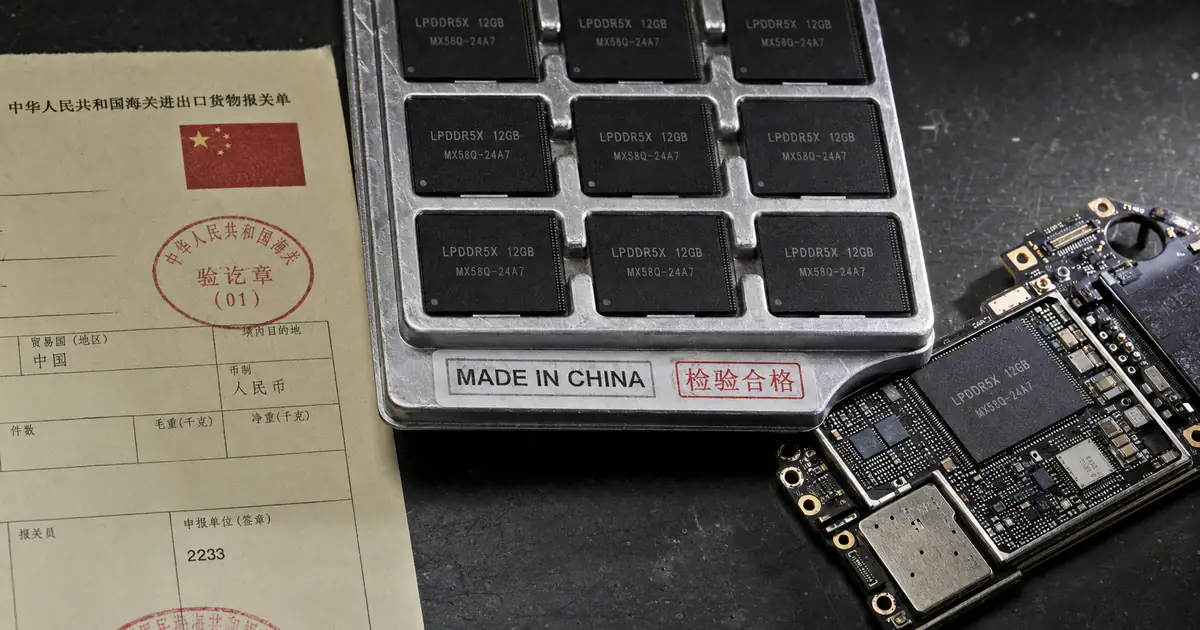
Apple wants permission to use memory made by China's ChangXin Memory Technologies (CXMT) and Yangtze Memory Technologies (YMTC), both major Chinese memory manufacturers. The request is not limited to devices for the Chinese market. It covers products sold anywhere outside the US, according to the report.
"In recent weeks, Apple Chief Executive Tim Cook and top executives have pitched Trump and officials including Commerce Secretary Howard Lutnick and Treasury Secretary Scott Bessent on a plan to use memory chips from China's ChangXin Memory Technologies and Yangtze Memory Technologies in Apple products sold outside the U.S., people familiar with the discussions said." — Wall Street Journal report, quoted by 9to5Mac
Both companies have been designated Chinese military companies by the Pentagon, and YMTC is also on the Commerce Department's Entity List, the list of companies that require a licence before US technology can be transferred to them. Using their chips in products sold outside the US is not automatically prohibited. It is still politically awkward.
"For context, CXMT and YMTC have been designated as Chinese military companies by the Pentagon, and YMTC is also on the Commerce Department's Entity List." / "This does not necessarily prohibit Apple from using their chips in products sold outside the US, but it has made any potential deal politically sensitive and prompted pushback against the company in the past." — 9to5Mac
Why Micron Objects
The objection comes from Micron, the only US memory maker of meaningful scale. Its argument is that allowing Chinese suppliers to sell to US tech companies, regardless of where the product ends up, could destroy the domestic industry. Executives reportedly warned officials that it would repeat what happened to steel and manufacturing.
"Those arguments have been countered by Micron, the only sizable U.S. maker of memory chips. Micron executives including CEO Sanjay Mehrotra have warned Lutnick and other administration officials that allowing CXMT and other Chinese companies to sell to U.S. tech companies, regardless of the region of sale, could destroy the domestic industry the same way China played a role in decimating U.S. steel and manufacturing plants, the people said." — Wall Street Journal report, quoted by 9to5Mac
Micron has also offered an alternative: accelerating construction of domestic plants and increasing US investment to help ease the shortage.
"Additionally, the Journal reports that Micro says that it can help ease the shortage by accelerating construction of domestic plants and increasing US investment." — 9to5Mac ("Micro" in the original appears to be a typo for Micron)
The Memory Shortage and AI Demand
How memory got this tight
It looks like semiconductor politics. At the root is a contest over memory driven by AI.
AI Is Absorbing the Supply
How badly memory is wanted shows in Micron's own results. CEO Sanjay Mehrotra said at the 24 June 2026 earnings announcement that the record results reflect the strategic value of memory in the AI era.
"“Micron’s record fiscal Q3 financial results and even stronger outlook for Q4 reflect the strategic value of memory in the AI era,” said Sanjay Mehrotra, Chairman, President and CEO of Micron Technology." — Micron official earnings release, 24 June 2026
The growth figures are extreme. Revenue for the quarter was $41.456 billion, more than four times the $9.301 billion of the year-ago quarter. HBM4, the stacked memory used for AI, is in high-volume shipments for a lead customer.
"Revenue of $41.46 billion versus $23.86 billion for the prior quarter and $9.30 billion for the same period last year" / "HBM4, built on 1-beta DRAM technology, is in high-volume shipments for our lead customer's platform, and qualification samples have been shipped to multiple end-customers." — "Fiscal Q3 2026 highlights" and "Product highlights" of Micron's official earnings release (revenue matches the consolidated income statement)
Where the growth sits is published as well. The two data centre business units alone reached close to $25.3 billion in revenue, up roughly fivefold from around $4.9 billion a year earlier. AI demand absorbing memory shows up directly in the numbers.
"Cloud Memory Business Unit / Revenue $13,769 $7,749 $3,386" / "Core Data Center Business Unit / Revenue $11,524 $5,687 $1,530" — "Quarterly Business Unit Financial Results" table (FQ3-26 / FQ2-26 / FQ3-25) of Micron's official earnings release
DRAM is the main memory in PCs and smartphones. While data centre revenue grew around fivefold in a year, the same kind of memory also goes into PCs and smartphones. That strength of AI demand leads straight into the question of consumer prices.
How Apple's Price Increases Fit
Apple raised prices on several products last month, citing the continuing memory shortage. Just before those increases, CEO Tim Cook told the Wall Street Journal that the US should reconsider its decision to restrict access to certain Chinese suppliers. The current request follows from that.
"Last month, just before Apple hiked prices for several of its products due to the ongoing memory shortage, Tim Cook gave an interview to The Wall Street Journal, where he suggested that the US should reconsider its decision to restrict access to certain Chinese suppliers." — 9to5Mac
Investment in AI feeding back into device prices is what surfaces here. On procurement moves around AI infrastructure, see AMD investing up to $5B in Anthropic and OpenAI's in-house inference chip "Jalapeño".
Lining up the WSJ original against the 9to5Mac write-up goes faster if you tidy the English pages into a readable form first.
The Administration's Dilemma
Two priorities in collision
Either way, one of the administration's stated goals gives ground.
Forced to Pick One
The Wall Street Journal reports that the dispute puts the administration in an uncomfortable position. Cutting prices for US consumers, and increasing domestic semiconductor production to reduce dependence on other countries: the lobbying fight will likely force a choice between the two.
"the lobbying fight will likely force Trump to choose between two of his top economic priorities: cutting prices for U.S. consumers and increasing domestic semiconductor production to reduce dependence on other countries." — Wall Street Journal report, quoted by 9to5Mac
A White House spokesperson told the Journal only that the administration would pursue investments and economic relief for the American people while safeguarding national security. Which way it leans was not indicated.
"In a statement to the Journal, a White House spokesperson offered little direct indication of how the administration plans to square Apple's and Micron's competing priorities, saying only that it would pursue “investments and economic relief for the American people while safeguarding our national security.”" — 9to5Mac
This Is Still at the Reporting Stage
What exists so far is a Wall Street Journal report based on people familiar with the discussions. Neither Apple nor the administration has publicly announced the contents of the request or any decision on it.
Semiconductor policy moves suppliers and prices every time it shifts. Until a decision lands, reporting and official statements sit side by side as separate things. On China's own push for domestic chips, see China's domestic AI chip pressure.
Conclusion
The Apple–Micron clash is a question of who absorbs the cost of a memory shortage created by AI demand. Apple wants cheaper components; Micron wants the domestic industry protected. Both cases hold together, which is exactly why the decision is hard.
It is not remote from ordinary buyers either. Memory prices feed straight into what phones and PCs cost, and the source of that pressure is AI data centre demand. This is less a semiconductor policy story than a price-tag story.
When you go to the original English coverage, a tool that turns a web page into something readable helps.