What Launched in ChatGPT Health
Availability as of July 23, 2026 (official figures)
A large number of people already bring health questions to ChatGPT. This announcement is best understood as OpenAI shaping the product around that existing behavior by letting you connect your own health data.
Rolling Out to Every U.S. Plan, Free Included
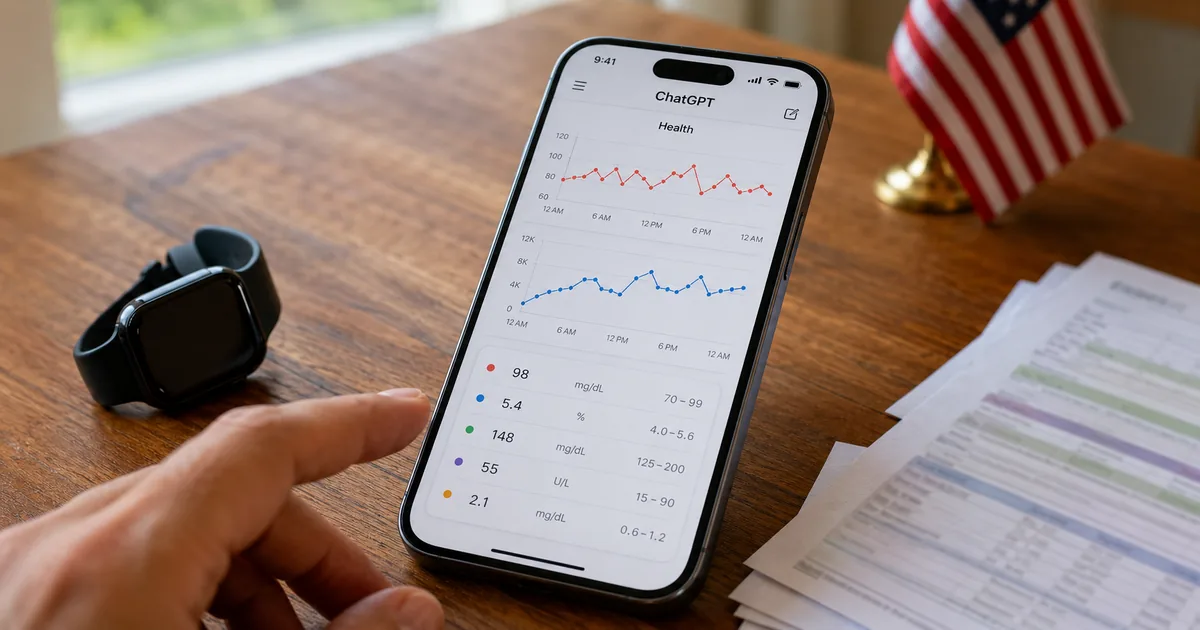
Health is the feature OpenAI built for the health domain. From July 23, 2026, the rollout began for logged-in users aged 18 and older in the U.S., on web and iOS, across the Free, Go, Plus, and Pro plans. It is not restricted to paid tiers; the free plan is included.
"We're beginning to roll out Health to logged-in ChatGPT users 18 and older in the U.S. on web and iOS across Free, Go, Plus, and Pro plans today. Open Health from the sidebar in ChatGPT to get started. Health is not yet available in Codex." — OpenAI Official Announcement
To start, open Health from the sidebar in ChatGPT.
According to OpenAI, more than 300 million people bring health-related questions to ChatGPT every week: reading a lab result, preparing for an appointment, making sense of what a doctor said, building a healthier routine.
"Every week, more than 300 million people turn to ChatGPT with health-related questions—from understanding a lab result and preparing for an appointment to making sense of what a doctor said and building a healthier routine." — OpenAI Official Announcement
The information behind those questions is scattered across patient portals, medical records, apps, and wearables, which makes the full picture hard to see. This feature is aimed squarely at that scattering.
Why the "Dedicated Space" Was Dropped
A similar feature reached some users earlier this year, but back then you had to move into a dedicated space inside ChatGPT for it to do much. That constraint is gone in this release: connected information can be referenced from anywhere in a conversation, with no separate space to enter.
"Among people with access, more than 70% of health-related conversations took place outside the dedicated health experience. Moving to a separate space added an unnecessary step." — OpenAI Official Announcement, "Health conversations grounded in your information"
The reasoning came from measured behavior. More than 70% of health-related conversations among people with access happened outside the dedicated experience. Health comes up naturally in the middle of other topics, the way a food allergy matters while you are planning meals. Making people move to a separate entrance broke that flow, and OpenAI judged it an unnecessary step.
What You Can Connect and What It Does
Getting started
Connecting a source is optional. You can ask health questions with nothing linked at all. The design is to connect only as much as you need when you want answers grounded in your own data.
Four Sources You Can Connect
The list of destinations is short. You can connect Apple Health, supported medical records from U.S. hospital systems, One Medical, and Function Health.
"To use Health and get responses grounded in your own information, you can choose to connect Apple Health, supported medical records from U.S. hospital systems, One Medical, or Function Health." — OpenAI Official Announcement, "How to connect and use your health information"
If you use a wearable or a nutrition app, turning on sharing from that app to Apple Health lets ChatGPT read it through Apple Health. What comes through varies by app and metric, though, and a vendor's own proprietary scores may not carry over.
"Available information varies by app and metric, and some proprietary scores may not transfer." — OpenAI Official Announcement, "Using a wearable or another health app?"
OpenAI also cautions that synced content is not always current. A medication you stopped taking can still be listed. Tell ChatGPT when something changes, and check important details against the original source. That bit of manual work remains.
"Connected information may not always be complete or current, for example, a medication may remain listed after you stop taking it, so tell ChatGPT when something changes and check important details against the original source." — OpenAI Official Announcement, "Review and update relevant health details"
What It Can Do
The value sits in reading scattered information together. Comparing a new lab result against past values, summarizing what has changed since your last visit, tracing the relationship between sleep or activity levels and your routine: these are the intended uses.
It removes the need to retype the same background every time. Have it account for a dietary restriction while you are discussing meals, or keep the weekend workout light because of a recent injury. Health context now flows into other topics naturally. For handling lab results that arrive as PDFs, see how to load PDFs into ChatGPT.
Which Model Answers
Health conversations are routed to models with dedicated training. The free plan uses GPT-5.5 Instant; paid plans use GPT-5.6 Sol. OpenAI positions GPT-5.6 Sol as its strongest model in the health domain.
"Every GPT-5.6 model outperformed GPT-5.5 on HealthBench Professional, an evaluation of AI performance on challenging health tasks." — OpenAI Official Announcement, "Improving health intelligence with physicians"
The evaluation was built with physicians from around the world and looks at accuracy, safety, communication, context awareness, completeness, and how appropriately the model encourages seeking care. Every GPT-5.6 model beat GPT-5.5 on HealthBench Professional, an evaluation of challenging health tasks. For how the models differ, see GPT-5.6 Sol, Terra, and Luna compared.
Privacy Handling and Availability Outside the U.S.
Protections applied to health data (as stated officially)
Health information is unusually sensitive. OpenAI describes measures for Health that sit on top of ChatGPT's usual protections.
Not Used for Training or Ads
Where the data goes is the first question for most people. Connected medical records and Apple Health information, and the conversations that use them, are not used to train foundation models or to target ads. That holds regardless of which model-training setting you have chosen in ChatGPT.
"The information connected in Health is not used to train our foundation models or target ads. Connected medical records and Apple Health information, and conversations that use it, are not used to train our foundation models or target ads, regardless of the model-training setting you choose for ChatGPT." — OpenAI Official Announcement, "Built with privacy, security, and control"
Encryption is also stepped up. ChatGPT conversations are already encrypted at rest and in transit, and information connected through Health carries additional encryption protections on top of that.
Designed to Ask Permission Each Time
You also control when it gets referenced. By default, ChatGPT asks for permission every time before using connected medical records or Apple Health information in a response. If approving each time gets tedious you can switch to always allow, and you can change it back from settings whenever you like.
Disconnecting is available at any time. When you disconnect, data synced from that source is deleted from OpenAI's systems within 30 days. Information already pulled into your conversation history stays until you delete those conversations, which is worth treating as a separate matter.
There are also brakes on sharing health information outward. If ChatGPT is about to take an action in another connected plugin that could disclose health information, such as sending a training plan based on your Apple Health data to a running partner, safeguards check that the sharing matches your request, and some sensitive actions require confirmation first.
"Before ChatGPT takes an action in another connected plugin that could disclose Health information, like sending your running partner a training plan based on your Apple Health data, additional safeguards help check that the sharing matches your request. For some sensitive actions, ChatGPT may ask you to confirm before proceeding." — OpenAI Official Announcement, "Built with privacy, security, and control"
Availability Elsewhere, and Why It Is Not a Substitute for Care
For readers outside the U.S., the answer for now is to wait. The announcement names U.S. users as the audience for this rollout and says nothing about timing for other regions. There is no material in the announcement to reason from about availability elsewhere.
There is a second caveat, about the nature of the feature itself. Health supports the care of medical professionals rather than replacing it, and it is not intended for diagnosis or treatment.
"While these results represent meaningful progress and we are continuously improving our models, ChatGPT can still make mistakes and does not replace the care and judgment of qualified medical professionals. We encourage people to verify important information and discuss medical decisions with their healthcare provider." — OpenAI Official Announcement, "Improving health intelligence with physicians"
Physicians tested it extensively before launch, and OpenAI states plainly that it can still be wrong. Verify important information against the original source, and discuss medical decisions with your healthcare provider. That is the usage OpenAI describes.
Read as a whole, this is less a new health AI capability than a cleared path for getting your own scattered health information into ChatGPT. In the U.S. it is usable on the free plan, and the trip to a dedicated space is gone. Elsewhere, the wait continues. For ChatGPT itself, see the ChatGPT (GPT-5) usage guide.
Lab results and medical statements often arrive as PDFs split across several files, which makes them awkward to work with. When you want to combine them into one file before uploading, this tool helps.