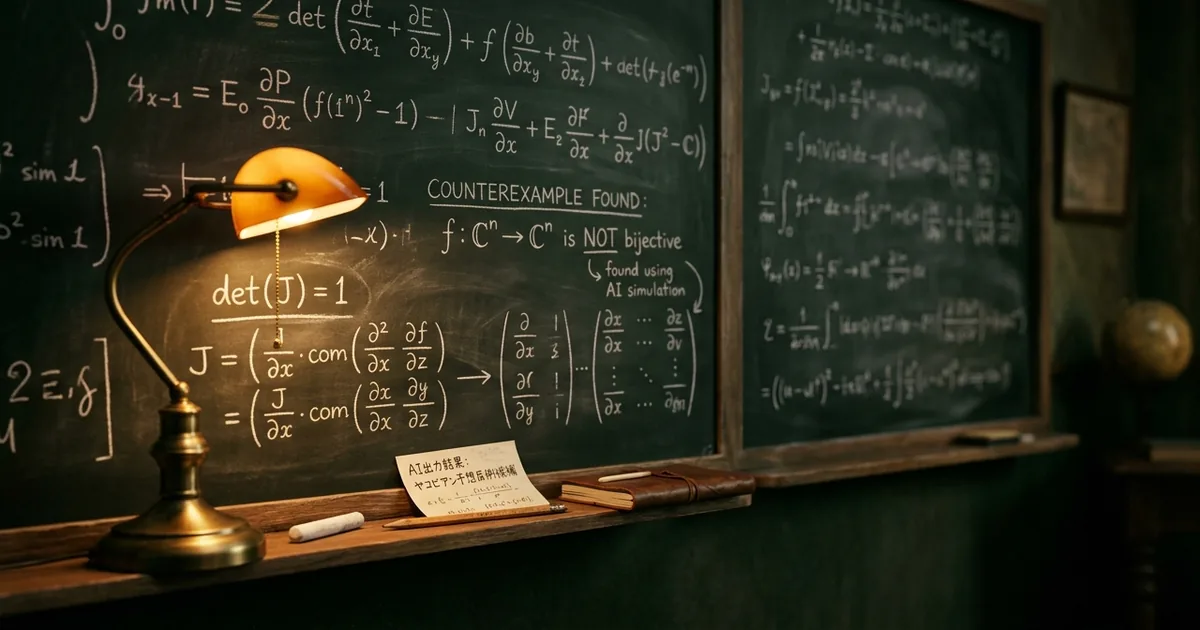
A Counterexample to the Jacobian Conjecture Was Found
What happened at a glance
Let's start with what the Jacobian conjecture is and how Claude Fable 5 was involved.
The Jacobian conjecture (1939, an 87-year problem)
The Jacobian conjecture is an open problem about polynomial maps, proposed in 1939 by the German mathematician Ott-Heinrich Keller. Roughly, it says a polynomial map whose Jacobian determinant (a measure of the map's local rate of change) is a non-zero constant must have a polynomial inverse, meaning it can be cleanly reversed. The conjecture long harbored a trap: being fine locally does not guarantee it can be reversed globally, and it stood as a hard problem for 87 years.
"The Jacobian conjecture was set out by Ott-Heinrich Keller in 1939. In rough terms, it says that a certain kind of polynomial map, one whose Jacobian determinant is a non-zero constant, must be reversible with a neat polynomial inverse. It became one of the field's most stubborn open problems." — From the article
Claude Fable 5 helped search for the counterexample
Alpöge, a researcher at Anthropic, announced on July 20, 2026 that he found the counterexample with help from Claude Fable 5, sharing the formula in his own post on X. The post is casual, opening with thanks to a friend who asked about the problem and to Fable for helping during the search. The key point is that AI did not solve the problem alone; a mathematician used Fable 5 as a research collaborator. One mathematician involved noted it was "not a one-line prompt."
"hello there the jacobian conjecture is false thanx to my close friend akhil for asking about it and my other close friend fable for working during the world cup final" — From Alpöge's post on X
The Counterexample Anyone Can Check
The counterexample polynomial map (from Alpöge's post)
(1+xy)³z + y²(1+xy)(4+3xy),
y + 3x(1+xy)²z + 3xy²(4+3xy),
2x − 3x²y − x³z
) (map F: ℂ³ → ℂ³; the Jacobian determinant is −2 everywhere)
Let's see why this formula breaks the conjecture, and why anyone can verify it.
The Jacobian determinant is constant, yet the map is not injective
For this map, the Jacobian determinant is the constant −2 (non-zero) at every point, satisfying the conjecture's premise. Yet the following three different inputs all map to the same output, (−1/4, 0, 0). When different entrances lead to the same exit, the map cannot recover its original input uniquely. In short, it satisfies the local condition but has no inverse globally, striking exactly at the conjecture's weak point.
Three inputs map to the same output (evidence it is not injective)
"passes the local check at every point, yet it sends three different input triples to the same output" — From the article
You can verify it in Wolfram Alpha
This counterexample draws attention because confirming it requires no advanced theory. Substitute the three values above into the formula, and anyone reaches the same conclusion. Alpöge included Wolfram Alpha links to reproduce the calculation, and mathematicians worldwide have checked it independently since it went public. Because the computation can be verified even before peer review, there is little uncertainty about whether it is correct.
"Alpoge included Wolfram Alpha links where the calculations can be reproduced." — From the article
Its Pre-Peer-Review Status and the Reactions
How to read it (from reporting)
While it is a major result, there is a caveat about how much to treat as settled.
It is one counterexample, and peer review is still ahead
What is settled so far is that one counterexample was presented and passed initial checks. Formal peer review is still ahead, and a detailed write-up is said to follow. Finding a counterexample is different from theoretically explaining "why" the conjecture is false; this is a specific single counterexample.
"A full write-up, he added, will follow." — From the article
Experts are divided
Reactions are not uniform. Some mathematicians praise it as the most famous open problem yet resolved with the help of an LLM, while others take it calmly as within the range of what AI is good at and not something that changes their view. The point they raise is that checking large numbers of polynomials is hard for people but not hard for machines. Keeping in mind that its significance is acknowledged while it is seen as a win by computational volume rather than deeper theory gives a balanced understanding.
"This did not cause me to update my priors. This is exactly what he expects AI to be good at." — From Andrew Blumberg's assessment
Summary: An Example of AI as a Mathematician's Collaborator
The report is that a mathematician using Claude Fable 5 found one concrete counterexample to the Jacobian conjecture, which had stood for 87 years. The counterexample is published so anyone can check it, so uncertainty is small, while formal peer review is still ahead and it does not come with a theoretical explanation of why the conjecture is false. The accurate reading is that AI did not solve the hard problem alone; a mathematician used AI as a collaborator in the search and produced the result. For Claude's model lineup, see the comparison of Claude Fable, Opus, Sonnet, and Haiku as well.