What was approved, and how far it goes
The notice is a concrete look at how regulators have started handling AI-equipped vehicles.
Carved out of portions of eight safety standards
The exemption covers certain requirements within eight FMVSS: windshield defrosting and defogging systems (No. 103), windshield wiping and washing systems (No. 104), lamps, reflective devices and associated equipment (No. 108), rear visibility (No. 111), light vehicle brake systems (No. 135), occupant protection in interior impact (No. 201), glazing materials (No. 205), and occupant crash protection (No. 208).
Lay them out and a pattern appears. Defogging, wipers, and rear visibility are requirements built around a human looking forward and driving. In a car with nobody driving, what it means to satisfy them changes.
The eight FMVSS covered by the exemption (per the Federal Register notice)
The Zoox robotaxi is a passenger car that is equipped with an ADS and lacks manually operated driving controls. / NHTSA is granting an exemption to Zoox, Inc. (Zoox) to allow it to manufacture and deploy commercially a passenger car, which is equipped with an Automated Driving System (ADS), that does not comply with certain requirements in the Federal Motor Vehicle Safety Standards (FMVSS). Specifically, NHTSA grants Zoox an exemption for its Zoox sedan from certain requirements in eight FMVSS: FMVSS No. 103, Windshield defrosting and defogging systems; FMVSS No. 104, Windshield wiping and washing systems; FMVSS No. 108, Lamps, reflective devices, and associated equipment; FMVSS No. 111, Rear visibility; FMVSS No. 135, Light vehicle brake systems; FMVSS No. 201, Occupant protection in interior impact; FMVSS No. 205, Glazing materials; and FMVSS No. 208, Occupant crash protection. — From the passage describing the eight standards covered by the exemption
Two years, 2,500 vehicles a year
This is not an open-ended approval. The term runs from July 31, 2026 through July 31, 2028. On the business side of robotaxis, the end of the Waymo–Uber exclusivity deal belongs to the same market shift.
There is a volume ceiling as well. No more than 2,500 exempted vehicles may be introduced into interstate commerce for commercial deployment in any 12-month period. Within that ceiling, Zoox may manufacture vehicles under this exemption.
Zoox is permitted to manufacture vehicles pursuant to this exemption for two years, provided that not more than 2,500 exempted vehicles are introduced into interstate commerce for commercial deployment in any 12-month period. / DATES: NHTSA grants Zoox's exemption effective from July 31, 2026 through July 31, 2028. — From the passages on the exemption's effective period and the 12-month volume cap
A first for passenger-carrying self-driving vehicles
The notice spells out where this sits historically. The Zoox robotaxi is the first passenger-carrying ADS-equipped vehicle granted an exemption under NHTSA's general exemption authority.
It is also the first exemption issued since NHTSA introduced process improvements under the Department's Automated Vehicle (AV) Framework. The notice lists that framework's three core principles: prioritizing the safety of ongoing AV operations on public roads, unleashing innovation by removing unnecessary regulatory barriers, and enabling the commercial deployment of AVs to enhance safety and mobility.
Working through regulatory primary sources is tedious, but keeping notices like this in a readable form pays off when you need to check them later.
The Zoox robotaxi is the first passenger-carrying ADS-equipped vehicle to be granted an exemption under NHTSA's general exemption authority. / It is also the first exemption to be issued since NHTSA introduced process improvements under the Department's Automated Vehicle (AV) Framework. / These process improvements have been made in accordance with the AV Framework's three core principles: (1) prioritize the safety of ongoing AV operations on public roads; (2) unleash innovation by removing unnecessary regulatory barriers; and (3) enable the commercial deployment of AVs to enhance safety and mobility for the American public. — From the passages on the first-of-its-kind status and the AV Framework's three principles
What kind of vehicle is it
The notice also describes the vehicle itself. Its shape departs from a conventional passenger car.
Identical front and rear, and nobody can drive it
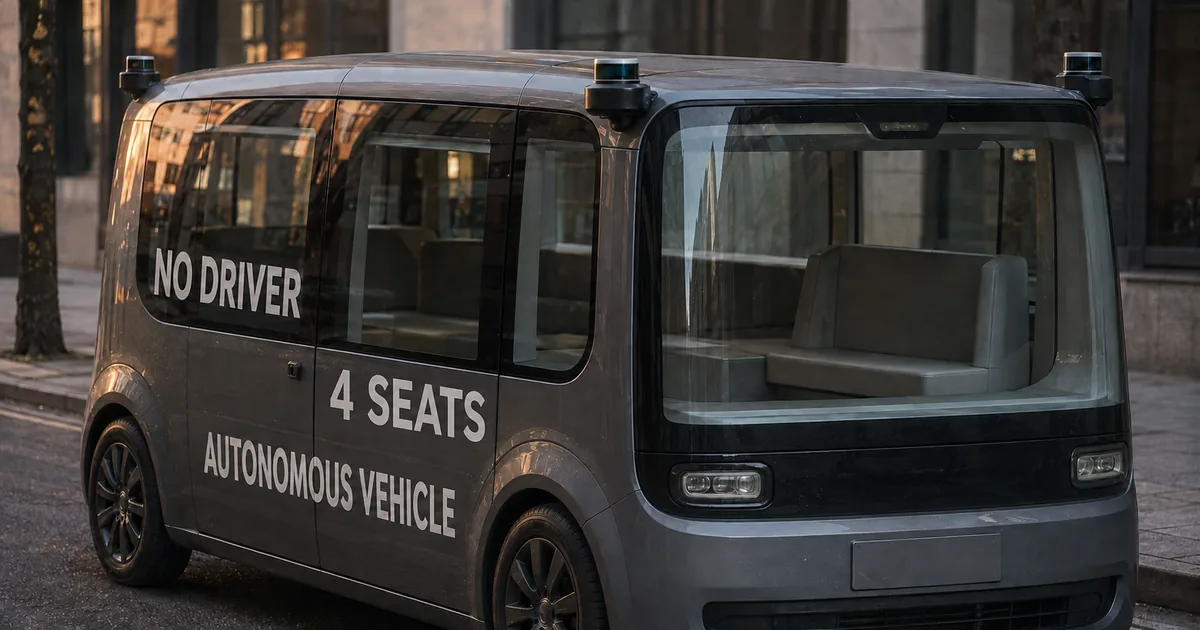
By Zoox's description, the robotaxi is a purpose-built, fully autonomous, all-electric vehicle optimized for ride hailing in cities. It is classified as a passenger car with a top speed of 75 mph (about 120 km/h), seats a maximum of four passengers, and has a gross vehicle weight rating of 3,000 kilograms (6,614 pounds).
The form is unusual. The body is symmetrical — the front and rear are identical. Instead of forward-facing rows, the seats sit in a carriage-style arrangement with occupants facing the center of the cabin.
Then comes the decisive difference. Zoox states that the primary difference between the robotaxi and a nonexempt vehicle is that the robotaxi is not capable of being driven by a human. The steering wheel was not removed; the car was never designed for a person to drive.
Zoox describes the robotaxi as a purpose-built, fully autonomous, all-electric vehicle optimized for ride hailing in cities. It is classified as a passenger car and has a top speed of 75 mph. The vehicle seats a maximum of four passengers and has a gross vehicle weight rating (GVWR) of 3,000 kilograms (6,614 pounds). / Unlike conventional human-driven cars, the Zoox robotaxi is symmetrical, meaning its front and rear are identical. Rather than forward-facing rows, the Zoox robotaxi's seats are configured in a carriage-style arrangement where seated occupants face the center of the cabin. / Zoox states that the primary difference between the Zoox robotaxi and a nonexempt vehicle is that the Zoox robotaxi is not capable of being driven by a human. — From the passages on the vehicle's specifications, its symmetrical shape, and the fact that no human can drive it
Sensors and in-house software do the driving
The driver here is the onboard system. The vehicle carries lidar, radar, cameras, long-wave infrared cameras, microphones, and other sensors, which perceive the environment through custom perception software.
That information feeds into planner and control systems that plan and execute driving maneuvers. In the same "AI acting in the physical world" territory, the Gemini Robotics 2 announcement and the experiment in having Claude operate a robot landed around the same time.
Zoox states the ADS was developed entirely in-house, made up of hardware and software that can perform the entire dynamic driving task and fallback on a sustained basis within a specified operational design domain (ODD), without any expectation that a passenger will need to intervene. On that basis, Zoox says the system meets the description of a Level 4 ADS under SAE J3016 (April 2021).
Instead, the Zoox robotaxi is equipped with lidar, radar, cameras, long-wave infrared cameras, microphones, and other sensors that perceive the environment with custom perception software. This information is then fed into planner and control systems which plan and execute the driving maneuvers autonomously. / Zoox states that its ADS is developed entirely in-house and consists of the hardware and software collectively capable of performing the entire dynamic driving task and fallback on a sustained basis within a specified operational design domain (ODD), without any expectation that a passenger will need to intervene. / Zoox states that, therefore, their system meets the description of a Level 4 ADS under SAE J3016: Taxonomy and Definitions for Terms Related to Driving Automation Systems for On-Road Motor Vehicles (April 2021). — From the passages on the sensor suite and the claim that the system corresponds to SAE J3016 Level 4
The reasoning, and the oversight that follows
The logic behind the exemption and the supervision structure after the grant are the other half of what makes this notice worth reading.
"Complying would keep it off the road"
NHTSA's stated basis is direct: requiring compliance would prevent Zoox from selling or commercially deploying a motor vehicle whose overall safety level is at least equal to that of a vehicle meeting all applicable FMVSS — so the exemption was granted.
This is not the same as loosening a safety standard. Applying the text as written to a vehicle the text never anticipated produces an unreasonable result, so the agency measured against overall safety level instead. Rules drafted around a human driver can spin uselessly when nobody is driving. This decision is a formal recognition of that.
NHTSA is granting Zoox's application on the basis that compliance with these requirements would prevent Zoox from selling, or otherwise commercially deploying, a motor vehicle with an overall safety level at least equal to the overall safety level of a vehicle that complies with all applicable FMVSS. — From the passage on the "overall safety level" basis for granting the exemption
Conditions split into two kinds
The design of the conditions is distinctive. The grant conditions are fixed because they contributed to NHTSA's overall safety finding, and they cannot change without a modification to the exemption itself. Zoox must comply with them for the life of the exempted vehicles.
At the same time, NHTSA anticipates that Zoox's operations, ODD, and use case will change over time. So a second layer exists to track that change: the Operational Authorization, which may update and expand as Zoox's ADS technology matures.
The safety foundation stays put; the operating envelope moves with the technology. That two-layer structure is a useful template for regulating AI systems whose capabilities keep shifting.
Fixed conditions versus updatable ones (per the Federal Register notice)
| Grant conditions | Operational Authorization | |
|---|---|---|
| What it is | Conditions that contributed to the overall safety finding | Operating authorization issued by NHTSA under the enhanced oversight condition |
| Can it change | Not without a modification to the exemption itself | May update and expand as the ADS technology matures |
| How long it binds | For the life of the exempted vehicles | Follows whatever the authorization currently says |
The grant conditions are considered fixed conditions because they contributed to NHTSA's overall safety finding and therefore cannot be changed without a modification to this exemption. Zoox must comply with the grant conditions for the life of the exempted vehicles. / In addition, NHTSA anticipates that Zoox's operations, ODD, and use case will change over time. / NHTSA grants Zoox an exemption subject to certain specified terms and conditions, including the application of an enhanced oversight condition. Under this condition, NHTSA will issue Operational Authorizations that may update and expand as Zoox's ADS technology matures. — From the passages on the fixed-and-updatable two-layer oversight structure and the expectation that operations will change
Takeaway: fitting existing law to machines that run on AI
The number to take away from this notice is neither the vehicle count nor the top speed. It is that a regulator gave a concrete answer to the question of how rules written for human operation apply to a machine no human operates.
The answer has three parts. First, measure against overall safety level rather than clause-by-clause compliance. Second, freeze the conditions that underpinned the safety finding. Third, let an updatable authorization track the operational side as it changes. That split travels well beyond cars — it applies to AI systems whose capabilities keep getting revised.
From the regulatory side, the EU AI Act's entry into application shows a different approach to the same problem. Technology runs ahead, and the rules change shape behind it. This notice shows that process in motion, with the specific clause numbers attached.