Pricing and Performance
Claude Opus 5 at a glance
The part of this release that actually bites is that performance moved and the price did not.
Pricing Held at Opus 4.8 Levels
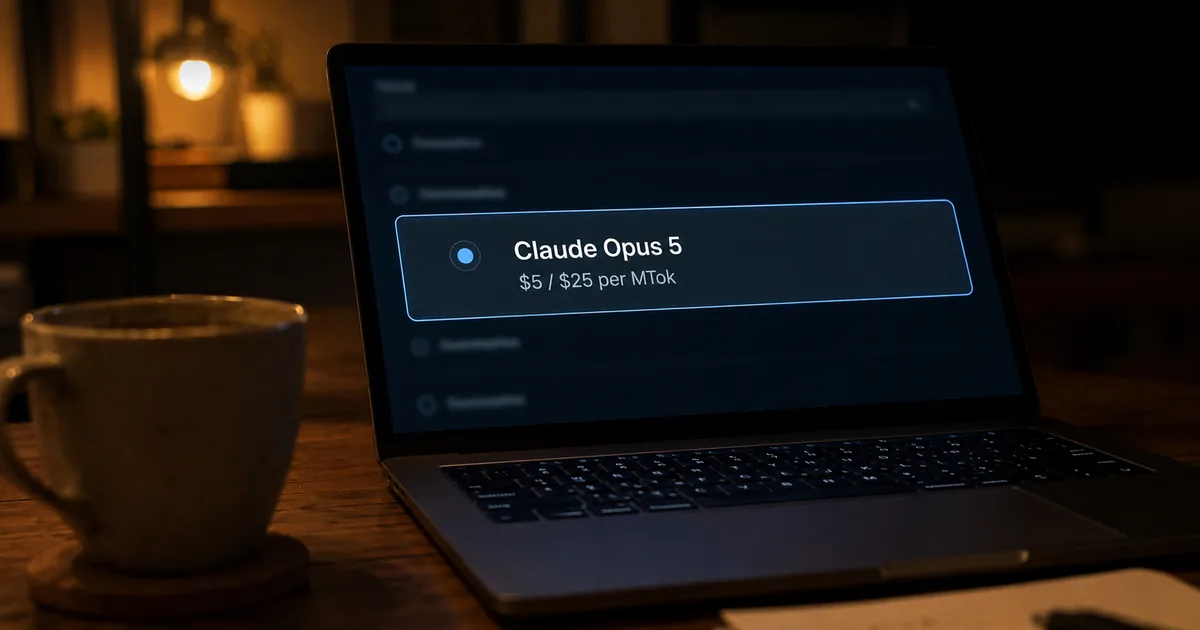
Claude Opus 5 costs $5 per million input tokens and $25 per million output tokens. Tokens are the small units text is split into, and AI pricing is calculated per token. The price is exactly what the previous Opus 4.8 charged, with performance the only thing that moved.
"Claude Opus 5 is available today on all platforms, priced at $5 per million input tokens and $25 per million output tokens (the same as Opus 4.8)." — "Getting started" section of Anthropic's official news post
The other axis is the gap to the tier above. Anthropic describes Opus 5 as coming close to the frontier intelligence of Claude Fable 5 at half the price. Fable 5 costs $10 input and $50 output, so the halving is literal.
"Claude Fable 5: $10 / input MTok $50 / output MTok" / "Claude Opus 5: $5 / input MTok $25 / output MTok" — Pricing row of the "Latest models comparison" table in the Claude Docs
The framing appears in the opening line of the announcement itself.
"Claude Opus 5 is available today. It’s a thoughtful and proactive model that comes close to the frontier intelligence of Claude Fable 5 at half the price." — opening of Anthropic's official news post
There is also a Fast mode for when speed matters, running at around 2.5 times the default. That one costs twice the base price.
"It’s also offered in Fast mode, where it runs around 2.5 times the default speed. As with Opus 4.8, Fast mode is available at twice Opus 5’s base price on the Claude Platform and through usage credits in Claude Code." — "Getting started" section of Anthropic's official news post
For how pricing has moved across generations, see the Claude Opus generation cost comparison.
Where It Lands on Benchmarks
Anthropic cites both coding and knowledge work. On Frontier-Bench v0.1, a software development evaluation, Opus 5 surpasses every other model and more than doubles Opus 4.8's score, while the cost per task goes down rather than up.
"For example, on Frontier-Bench v0.1, Opus 5 surpasses all other models, and more than doubles Opus 4.8’s performance at a lower cost per task. On CursorBench 3.2, at max effort, the model performs within 0.5% of Fable 5’s peak score, but at half the cost per task" — "Performance and cost-effectiveness" section of Anthropic's official news post
On CursorBench 3.2 the gap to Fable 5's peak score comes in under 0.5%, at half the cost per task. The pattern holds on the knowledge-work side. On ARC-AGI 3, which tests solving novel problems, Opus 5 scores three times as high as the next-best model, and on the computer-use benchmark OSWorld 2.0 it beats Fable 5's best result at just over a third of the cost.
"On ARC-AGI 3, an evaluation where the model has to solve novel problems, Opus 5’s score is three times as high as the next-best model." / "On OSWorld 2.0, a computer use benchmark, Opus 5 outperforms every other model at any given cost, surpassing Fable 5’s best result at just over a third of the cost." — "Performance and cost-effectiveness" section of Anthropic's official news post
Tuning Intelligence and Cost With Effort
How the effort setting works
Alongside price, the headline feature is that how much the model thinks is now your call.
What the Effort Setting Changes
Effort specifies how much work the model puts into thinking. Turn it up to prioritise intelligence, turn it down to conserve tokens for faster and cheaper results. Note that in the Japanese-language build of Claude Code this setting is labelled "工数" (workload), which our editorial team confirmed on the actual app; wording may differ by version.
"The charts in this section show how performance changes according to the model’s effort setting, which customers can use to optimize for intelligence or conserve tokens for faster and cheaper results." — "Performance and cost-effectiveness" section of Anthropic's official news post
Per the official documentation, the default on the Claude API and Claude Code is high. Without an explicit setting, it runs on the higher side.
"On Claude Opus 5 and Claude Sonnet 5, it defaults to `high` on the Claude API and Claude Code. Set `effort` explicitly to use a different level." — Note directly below the "Latest models comparison" table in the Claude Docs
The sub-0.5% gap to Fable 5's peak score on CursorBench 3.2 is the figure at max effort, meaning the thinking budget pushed to its ceiling.
Capacity for Long Sessions
The context window, meaning how much can be read in at once, is 1M tokens, with a 128k-token output ceiling. That holds up when you hand over long documents or an entire codebase and keep investigating and editing inside it.
"Context window: 1M tokens / Max output: 128k tokens / Reliable knowledge cutoff: May 2026" — Claude Opus 5 column of the "Latest models comparison" table in the Claude Docs
The point up to which its knowledge is considered reliable is May 2026. Anything more recent has to come from search or supplied documents. For Claude as a whole, see our guide to Claude, Anthropic's generative AI.
Safety and the Cyber Question
Safety headlines
A large share of the announcement is spent not on performance but on safety.
The Most Aligned Model to Date
Anthropic runs an automated audit of model behaviour before deployment. The result: Opus 5 was found to be the company's most aligned model so far, where alignment means how little the model deviates from intended behaviour.
"During pre-deployment testing, our automated behavioral audit found Opus 5 to be our most aligned model to date (as shown in the graph below). It adheres to Claude’s Constitution better than Opus 4.8, Sonnet 5, or Fable 5; exhibits the lowest rates of deceptive behavior; and is the least susceptible to being tricked into misuse." — "Alignment and safety" section of Anthropic's official news post
Its overall misaligned-behaviour score in that audit is 2.3, the lowest among Anthropic's recent models. Lower means fewer unintended behaviours.
"On our automated behavioral audit, Opus 5 scores 2.3 on overall misaligned behavior, the lowest of our recent models." — "Alignment and safety" section of Anthropic's official news post
It is also described as the best so far at avoiding reckless actions with irreversible side effects. The more work is handed to an AI to run unattended over long stretches, the more that property earns its keep.
Cyber Capability Is Deliberately Held Back
On offensive cyber work, a line is drawn. The model's ability to find vulnerabilities has risen close to Mythos 5, but its ability to turn those vulnerabilities into material threats, effectively writing working exploits, remains substantially behind.
"The model has nevertheless improved substantially on these tasks as a result of becoming more generally capable, and it comes close to Mythos 5 at finding cybersecurity vulnerabilities. However, it remains substantially behind Mythos 5 on the exploitation of those vulnerabilities—that is, in turning vulnerabilities into material cyber threats." — "Alignment and safety" section of Anthropic's official news post
That is deliberate: as with Opus 4.8, Anthropic says it intentionally avoided training Opus 5 on cyber tasks. So that legitimate security work is not blocked, enterprises and researchers already in the Cyber Verification Program have immediate access to a version with fewer security restrictions.
"As with its predecessor, Opus 4.8, we’ve intentionally avoided training Opus 5 on cyber tasks." / "Enterprises and researchers who are already part of the CVP have immediate access to a version of Opus 5 with fewer security restrictions." — "Alignment and safety" and "Safeguards for Opus 5" sections of Anthropic's official news post
Conclusion
Claude Opus 5 is a solid, practical update: the price stayed put and the performance went up. With a measured gap to Fable 5 under 0.5% on CursorBench 3.2 at half the cost, putting day-to-day production work on Opus 5 is the straightforward choice.
The effort switch lets you push hard problems to max and economise on routine tasks. On safety it takes the best alignment result Anthropic has published while keeping offensive cyber capability held back, and that boundary is stated plainly.
Official announcements come out in English, which makes reading the primary source work. When you want an English web page turned into something easier to read, the following tool helps.