What Samsung Actually Announced
Announcement basics (official figures)
Smart glasses are a category that has been hyped and abandoned more than once. This time the product arrives carrying Google's Gemini and shaped for daily wear with eyewear brands involved.
"Intelligent Eyewear," Announced at Galaxy Unpacked
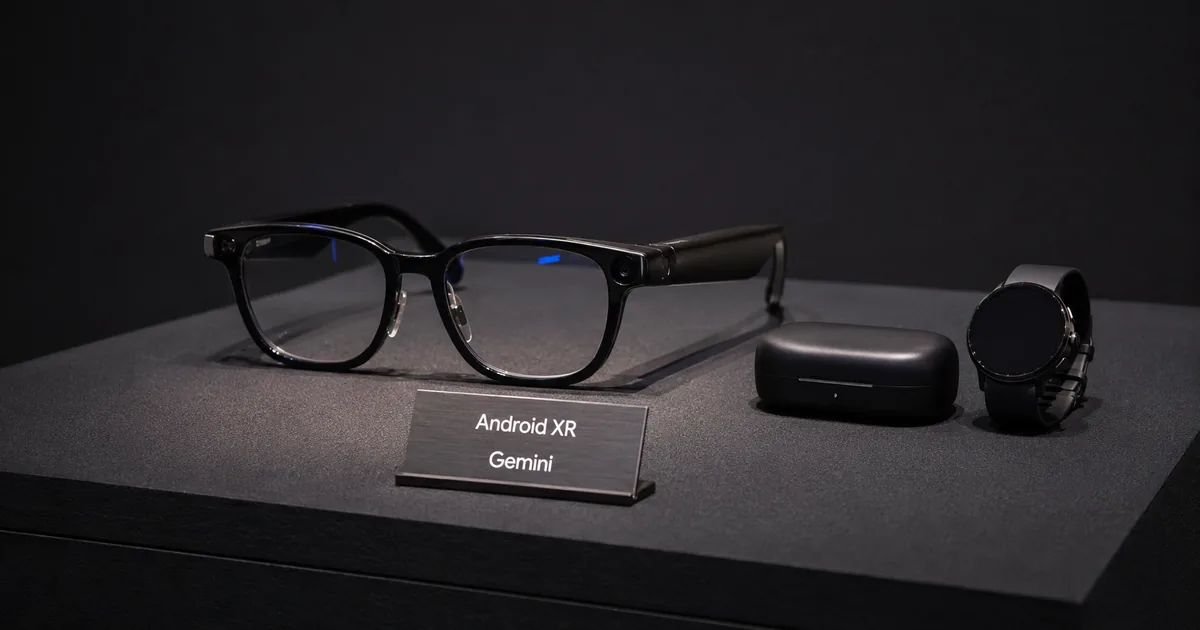
Start with the name. Samsung calls the product intelligent eyewear, and introduced it on July 22, 2026 at Galaxy Unpacked in London. It turns the concepts shown at the latest Google I/O into an actual product.
"Samsung Electronics today introduced its intelligent eyewear at Galaxy Unpacked in London. Building on the concepts announced at the latest Google I/O, the new designs were developed with global eyewear brands, Gentle Monster and Warby Parker." — Samsung Global Newsroom
The phrase Samsung keeps returning to is extending the Galaxy ecosystem beyond the phone. The phone remains at the center; the eyewear is positioned as a device that adds context to it.
Won-Joon Choi, Chief Operating Officer of the MX Business, says that as agentic AI reshapes the mobile experience, the next step is making that experience more intuitive and responsive to each person's situation. Speaking to the AI without the intermediate step of looking at a screen is the aim here.
Two Designs, from Gentle Monster and Warby Parker
What stands out this time is that design comes before technology in the pitch. Samsung worked with the eyewear brands Gentle Monster and Warby Parker, and showed two designs at Unpacked.
The Gentle Monster version is a slim black frame combining a straight upper rim with a rounded lower edge. The Warby Parker version uses brown tones with a slightly upswept brow line. During development, the key fit points at the brow and ears were worked out with both companies.
Because this is something worn every day, comfort and appearance outrank raw capability. Building the product in that order is what separates it from earlier smart glasses.
What It Can Do with Gemini and Android XR
Main capabilities Samsung describes
The features converge on a single idea: getting things done without taking the phone out. Here is what Samsung lists.
Voice and Gesture Control
Voice is the main entry point. Summarizing long messages, reading key information aloud, live translation, and control through simple voice or gesture interactions are the core capabilities Samsung names.
"The device can help summarize long messages, read key information aloud, support live translation and allow users to control the experience with simple voice or gesture interactions through connected devices." — Samsung Global Newsroom, "Key experiences include"
There is one condition that is easy to miss. Samsung's own note states that gesture control is available only through Watch9, so controlling the glasses by hand movement requires a compatible smartwatch as well. Touch controls are also built into the frame.
Capturing and Translating What You See
The camera exists less for taking photos than for handing context to the AI. On request, it captures what you are looking at, such as a whiteboard or a meeting discussion, and organizes the key points into Samsung Notes so they are easier to revisit or share later.
Navigation works the same way. Ask for a route from where you are, set a destination, get a sense of what is around you. Combined with live translation, it covers situations abroad where the language is a barrier. There is also a feature for sharing your field of view with the other party during a call, letting you show a situation without occupying your hands.
These capabilities come with conditions attached. Samsung states that experiences involving translation and navigation may vary by language, region, app, service provider, and network environment, and that view sharing and recording may vary by app, service, market, and applicable laws and consent requirements. There is no guarantee that every feature works identically everywhere.
The Roles of Android XR and Gemini
The foundation comes from Google. Gemini runs on the Android XR platform and responds to what you are looking at.
"Built on the Android XR platform, the intelligent eyewear blends world-class designs with Gemini's advanced assistance that naturally responds to what you see, delivering all-day, hands-free help." — Sameer Samat, President of the Android Ecosystem at Google
The chip is Qualcomm's Snapdragon AR1 Gen1 Platform. On top of the AI processing needed for real-time assistance, it has to handle touch input, connectivity, power efficiency, and thermal management inside the thin arms of a pair of glasses. For the Gemini models themselves, see the Gemini 3.6 Flash explainer and the Gemini 3.5 usage guide.
Launch, Price, and What Remains Unknown
Not yet settled
The more anticipated a product is, the easier it is to misjudge what has not been settled. Here is only what has actually been published.
Launching This Fall in Select Markets
The timing is stated. The first collections are scheduled to launch in fall 2026 in select markets, with additional details to be announced in the coming months.
"The first collections of intelligent eyewear are scheduled to launch this fall in select markets, with additional details to be announced in the coming months." — Samsung Global Newsroom (May 20, 2026)
Which markets count as "select" has not been published. Samsung also notes that availability may vary by market. Whether any particular country is in the first wave is not knowable from what has been released.
Price Has Not Been Announced
No pricing has been given. Neither the Galaxy Unpacked release nor the earlier Google I/O release names a figure. There is no official basis for inferring one from competing products either, so this is a wait-for-details item.
How to Read the Battery Figures
Even the published numbers need their assumptions checked. Battery life is given as up to nine hours on a single charge with up to seven additional full charges from the case, but Samsung notes that actual life varies with the network environment, the features and apps in use, device settings, and the number of charge cycles.
"Up to nine hours" is a ceiling, not a figure to plan a day around. Usage that keeps both the radio and AI processing busy, such as translation or view sharing, will run shorter.
What this announcement shows is one company's answer to where AI should sit. Keep the phone at the center, and add a single new entry point made of sight and voice. Partnering with eyewear brands is what makes that entry point something people will actually wear. A real verdict has to wait until the price and the market list are both on the table.
Photos taken on glasses or a phone are often too large to share comfortably as they are. When you want to slim them down while keeping the quality, this tool helps.