Why a Cellar Becomes "I Have No Idea What Is In There"
Before the methods, it helps to know why cellars fall apart, so you fix things in the right order. The causes come down to three.
Three reasons a cellar becomes disorganized
It will not hold the stated number
Catalog capacity is generally calculated with slim Bordeaux-shaped bottles.
The stated capacity of a wine cellar is usually based on Bordeaux-shaped bottles, so when you try to load wider bottles such as Burgundy or Champagne shapes, cases arise where it does not hold as many as the specification says.
The stated capacity of a wine cellar is usually based on Bordeaux-shaped bottles, so when you try to load wider bottles such as Burgundy or Champagne shapes, cases arise where it does not hold as many as the specification says. — From a wine cellar specialist's column
The more broad-shouldered Burgundy and Champagne bottles you own, the fewer fit on a tier. Plan around the number you actually loaded rather than the catalog figure, and the plan matches reality.
Stacking costs you both access and temperature
When bottles stop fitting, it is tempting to lay one more on top of those already on a shelf. Manufacturers are explicit about the side effects.
Storing bottles stacked on top of other wine bottles lets you fit more wine, but it not only makes the wine hard to remove, it also makes storage at the proper temperature difficult.
Storing bottles stacked on top of other wine bottles lets you fit more wine, but it not only makes the wine hard to remove, it also makes storage at the proper temperature difficult. — From the checklist item on whether the capacity preserves cooling efficiency
Retrieving a bottle from under a stack means lifting the ones above it first. That small friction is enough that people drink whatever is easy to reach at the front, and the back and bottom go untouched.
The cellar has not kept up with your buying
If there is no headroom to begin with, no arrangement will fix it. Manufacturers recommend building in slack when choosing a cellar.
When choosing a cellar, consider a size that can hold 1.5 to 2 times the number of bottles you currently own.
When choosing a cellar, consider a size that can hold 1.5 to 2 times the number of bottles you currently own. — From the section on choosing a cellar size
With a cellar you already own, the only ways to create slack are drinking faster or splitting storage across locations. Trying to solve a permanently full cellar through organizing alone will break down somewhere.
Choosing an Ordering Principle
The direct cause of disorder is placing bottles wherever there is room, with no principle. Start by settling on one axis.
Ordering axes, and how well each suits a home cellar
For a home cellar, lead with "when will I open it"
The troubles that arise in a 20-to-100-bottle cellar are usually two: missing a drinking window, and not being able to get at the back. Ordering by drinking window, meaning when you plan to open each bottle, addresses both at once.
Put what you will open soon on an easily reached tier, and what will rest for years on a tier you do not disturb. With that split, what you see when the door opens is what you should be drinking now. Ordering by type or region looks tidy but has the weakness of doing nothing for window management.
Bottle shape is the second axis
Once tiers are set by drinking window, adjust the arrangement within each tier by bottle shape. Wider bottles go where there is more clearance under the shelf above, and oversized formats such as magnums may need a shelf removed. For thick-bodied Burgundy shapes, alternating the direction bottles face fits more onto a tier.
If you have a dual-zone cellar
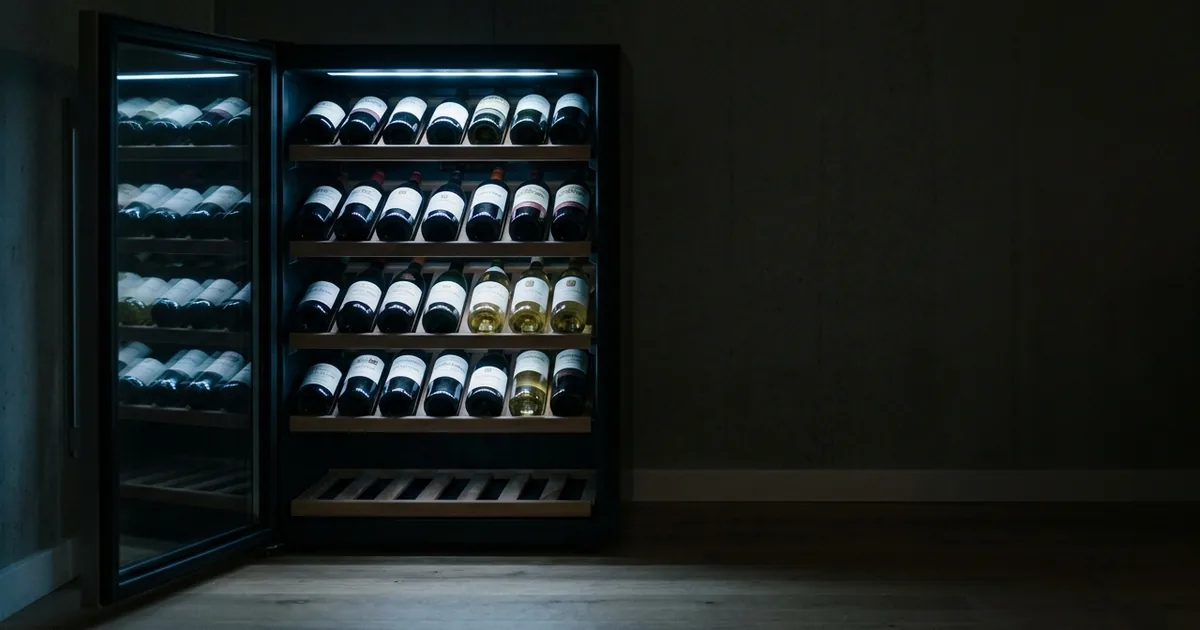
With separate upper and lower temperatures, you can run one compartment at storage temperature and the other at serving temperature. Manufacturer guidance gives an example of using the upper compartment at storage temperature, holding whites and sparkling wines too, with the lower one at serving temperature.
You may store them in the upper compartment set to storage temperature (12°C–15°C), together with white and sparkling wines.
You may store them in the upper compartment set to storage temperature (12°C–15°C), together with white and sparkling wines. — From the recommended usage for dual-temperature models
Which side runs warmer differs by model, though. Even within one manufacturer's guidance, articles assign the upper and lower compartments differently. Do not assume which compartment is the warmer one; check the manual for the cellar you actually own.
Assigning Roles to Each Shelf
With an axis chosen, give each tier a job. Once you do, opening the door tells you where to look.
Roles for each tier
Bottles at serving temperature should be finished within a month
If you run the daily tier at serving temperature, one condition comes with it: do not leave bottles there long.
We recommend keeping storage at serving temperature to within one month.
We recommend keeping storage at serving temperature to within one month. — From the caution about storing at serving temperature
Keep only a few bottles on the daily tier at any time and refill from the aging tier as you drink. That rotation is itself the mechanism that keeps windows from slipping past. Capping how many can sit there also removes the temptation to overfill it.
Leave one whole tier empty
Fill every tier and there is nowhere to set bottles down when you reach for one at the back, so they end up on the floor or a table. That friction is what makes organizing stop. Keep one tier empty and swaps have a landing place. It also serves as insurance against stacking.
Separate tiers if you store anything else
Home cellars often hold sake or beer as well, but odor needs attention.
Because wine ages by drawing in air through the cork, avoid storing it together with strongly scented items such as cheese.
Because wine ages by drawing in air through the cork, avoid storing it together with strongly scented items such as cheese. — From the caution about odors (POINT 05)
If they must share a cellar, separating them onto different tiers, as far apart as possible, is the workable compromise.
Do not leave the light on
A display-case look is tempting, but light degrades wine. Manufacturer guidance notes that even fluorescent light changes the flavor over long exposure.
Even under fluorescent light, wine exposed for long periods is said to lose fruit character and show sharper acidity, so take care.
Even under fluorescent light, wine exposed for long periods is said to lose fruit character and show sharper acidity, so take care. — From the explanation of light exposure effects
Switching the interior light on only while you are looking for something, and leaving it off otherwise, is the safer habit.
Recording Shelf Position So Nothing Gets Lost
Zoning gets you as far as "roughly over there." Recording the position of each bottle is what finally reduces how often you open the door at all.
Comparing ways to record position
Deciding the coordinate scheme
Before recording anything, settle how coordinates work. Count tiers from the top as 1, 2, 3, and slots from the left as 01, 02, 03. Combine them and 2-05 means the fifth bottle from the left on the second tier from the top. Writing the scheme on a slip taped to the cellar door means anyone in the household records it the same way.
Because lying bottles with the base facing out hides the label, pairing coordinates with shelf tags speeds up the check when you open the door.
Managing it in a spreadsheet
You can add a storage-location column to a spreadsheet and fill in coordinates such as 2-05. Put it in the cloud and you can check it while out, and sort by region or drinking window. Building that sheet is covered in detail in "Wine Inventory in Excel: Column Design and Where It Breaks."
The weakness is that updates are manual. If opening a laptop to fix the sheet after drinking does not stick, the sheet and the cellar drift apart. Choosing by whether the updates will continue, rather than by how precise the record can be, is what avoids failure.
Managing it in an app
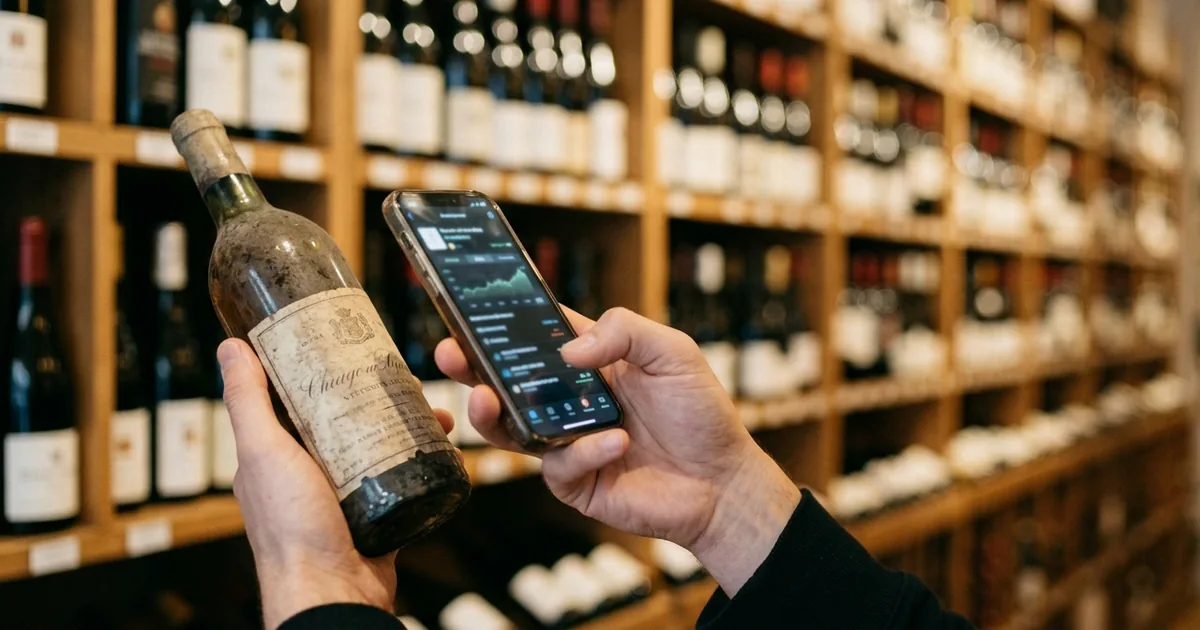
Some apps reproduce your cellar shelves on screen and record which wine sits on which tier.
Register multiple cellars and visually record which wines are located on which shelf (row/tier).
Register multiple cellars and visually record which wines are located on which shelf (row/tier). — From the graphical cellar management description
Because everything happens on a phone, you can remove a bottle from inventory the moment you drink it. Checking the contents without opening the door also limits temperature swings inside. Note that few wine apps record position down to the shelf; that is a different design from apps built for looking up ratings. Differences between apps are compared in "Best Wine Inventory Apps Compared: Which Ones Track Shelf Position."
Summary
Organizing a wine cellar starts with stopping two habits, overpacking and stacking, and then choosing a single ordering principle. For a home cellar in the 20-to-100-bottle range, lead with "when will I open it," make the easiest tier the daily tier, keep an undisturbed tier for aging, and leave one tier empty for working space. Those three roles alone largely eliminate stranded bottles at the back.
On top of that, recording each bottle's position as a coordinate such as 2-05 removes the need to open the door repeatedly while searching. A spreadsheet can do it, but whether the updates continue is the deciding factor. Choose the method by whether you can finish the record at the moment you drink, and the record stays aligned with the cellar.
If you want shelf-position management with a free tier that already includes it, starting from Shelvin (App Store) shows how much of the recording effort disappears. For the thinking behind drinking windows themselves, see "When Is Wine Ready to Drink? How Aging Works and How to Decide to Drink or Cellar."