What Qwen-Audio-3.0-TTS Is
Basics (official figures)
What this release pushes forward is the breadth of language coverage, the accuracy of voice copying, and how easy it is to direct the delivery.
Definition and Provider
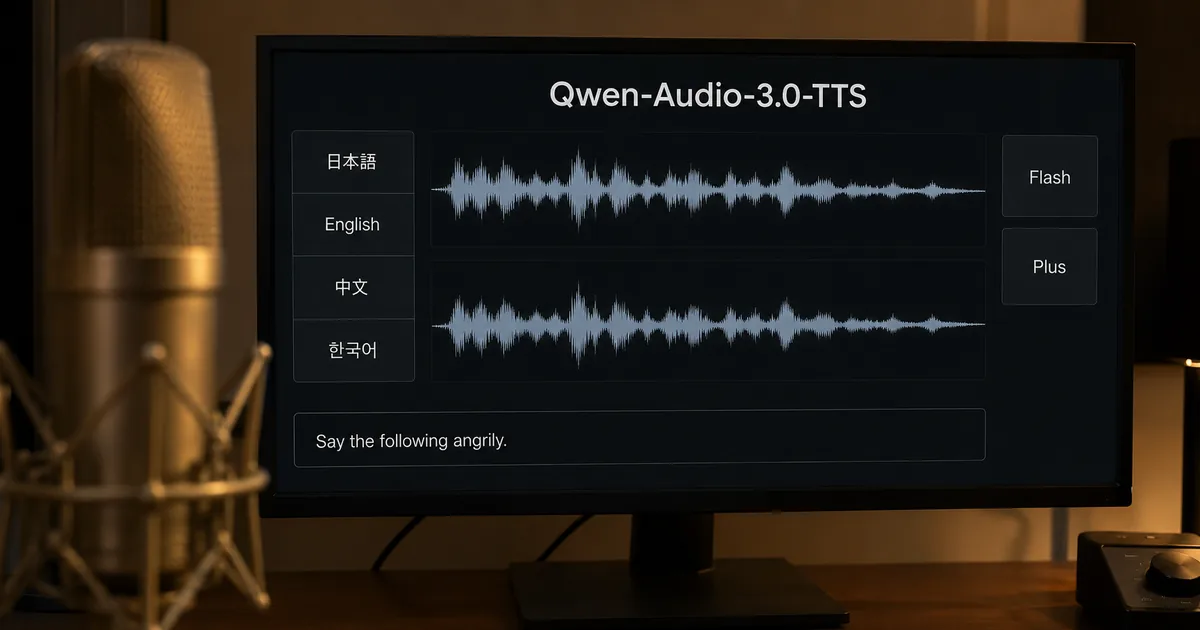
Qwen-Audio-3.0-TTS is Tongyi Lab's latest text-to-speech model release. Two variants ship from the same lineage: Flash and Plus.
"Qwen-Audio-3.0-TTS is our latest text-to-speech model release. It ships as two variants from the same lineage:" — Tongyi Lab Official Blog
TTS stands for text-to-speech, the technology that turns written text into spoken audio. Tongyi Lab is the AI research institute under Alibaba Group and the team behind the Qwen family of large language models. This release is the audio side of that work.
"We're Tongyi Lab — the AI research institute under Alibaba Group, and the team behind Qwen, Wan, Tongyi Fun, and a growing ecosystem of models and frameworks loved by millions of developers worldwide." — Tongyi Lab Official Blog, About page
Tongyi Lab names four things this release focuses on: broader language coverage, natural-language style control, fine-grained tag control, and robustness when the reference audio is not clean. All four are places where teams stumble once they actually put a model into production.
"This release focuses on four things developers actually run into in production: broader language coverage, natural-language style control, fine-grained tag control, and robustness when the reference audio isn't clean." — Tongyi Lab Official Blog, opening lead
The Difference Between Flash and Plus
The two variants are chosen by use case. Flash has a first-packet latency at the 300ms level and is tuned for real-time interaction. Plus is tuned for high-quality generation, where naturalness and timbre fidelity matter more than speed.
"Flash: tuned for real-time interaction, with a first-packet latency at 300ms-level. Plus: tuned for high-quality generation, where naturalness and timbre fidelity matter more than speed." — Tongyi Lab Official Blog
| Aspect | Flash | Plus |
|---|---|---|
| Tuned for | Real-time interaction | High-quality generation |
| First-packet latency | 300ms level | Not stated officially |
| Priority | Response speed | Naturalness and timbre fidelity |
| Average WER/CER | 3.87 (lowest) | 3.96 |
| Average speaker similarity | 80.44 | 82.75 (first in all 16 languages) |
| Suited to | Voice assistants and dialogue | Narration and dubbing |
The last row, "suited to," is not from Tongyi Lab; it is our reading of the rows above. The choice is simple. If a user speaks and waits for a reply, use Flash. If a prepared script needs to be read at high quality, use Plus. The only latency figure published is for Flash; there is none for Plus.
Not the Same as the Locally Runnable Qwen3-TTS
The name that gets confused with it is Qwen3-TTS. That is an open-source series of TTS models from the Qwen team at Alibaba Cloud, with published weights you can download and run on your own machine.
"Qwen3-TTS is an open-source series of TTS models developed by the Qwen team at Alibaba Cloud, supporting stable, expressive, and streaming speech generation, free-form voice design, and vivid voice cloning." — Qwen3-TTS official repository, About description
Qwen-Audio-3.0-TTS, by contrast, is a hosted API delivered through Model Studio. Whether a discussion assumes running weights on your own server or calling a cloud API changes both the options and the cost structure, so it is worth checking which one any given article means. For the large language model side of the family, see the Qwen3.8 explainer.
Sixteen Languages and Measured Performance
Speaker similarity (higher is closer to the original voice)
Figures as published by Tongyi Lab. Bars use a 0–100 scale.
The first question is usually whether a given language is read properly. Here are the supported languages and the two metrics Tongyi Lab publishes.
The 16 Supported Languages
The list is explicit. The 16 languages named are Arabic, Chinese, English, French, German, Indonesian, Italian, Japanese, Korean, Malay, Portuguese, Russian, Spanish, Tagalog, Thai, and Vietnamese.
"Supported languages (16): Arabic, Chinese, English, French, German, Indonesian, Italian, Japanese, Korean, Malay, Portuguese, Russian, Spanish, Tagalog, Thai, Vietnamese. *Full language support rolling out soon." — Tongyi Lab Official Blog, "Multilingual Coverage Across 16 Languages"
Optimization is described as naming English, Chinese, Japanese, Korean, and German while covering all 16 languages, and fidelity on several Chinese dialects is said to have improved as well.
"Qwen-Audio-3.0-TTS was optimized across English, Chinese, Japanese, Korean, German, and 16 languages total, plus improved fidelity on several Chinese dialects." — Tongyi Lab Official Blog, "Multilingual Coverage Across 16 Languages"
The demo audio on the official blog includes examples in the Hangzhou, Shannxi, and Shanghai dialects.
One condition applies. As the end of the quote above notes, full language support is still rolling out, so all 16 languages are not necessarily equally usable from day one.
Intelligibility (WER/CER)
WER and CER indicate how accurately speech is rendered. The Qwen-Audio-3.0-TTS family achieves the best WER/CER in 10 of 16 languages, averaging 3.87 for Flash and 3.96 for Plus, with both outperforming the other systems on average.
"Qwen-Audio-3.0-TTS family demonstrates the strongest overall multilingual intelligibility, achieving the best WER/CER in 10 of 16 languages. Flash delivers the lowest average WER/CER at 3.87, while Plus remains highly competitive at 3.96, both outperforming the other systems on average." — Tongyi Lab Official Blog, "Multilingual Coverage Across 16 Languages"
WER is word error rate and CER is character error rate, both measuring how many mistakes appear when the generated audio is transcribed. Lower is better on these metrics. The smaller the number, the less likely a listener is to mishear a word.
Which systems the comparison covers is not stated in the official blog, so these figures cannot be used to claim a head-to-head win over any specific product.
Voice Resemblance (Speaker Similarity)
The second metric is speaker similarity. Plus ranks first across all 16 languages with an average of 82.75, and Flash follows at 80.44.
"Plus ranks first across all 16 languages with an average SS of 82.75, while Flash follows at 80.44, demonstrating strong and robust voice-preservation quality across diverse languages." — Tongyi Lab Official Blog, "Multilingual Coverage Across 16 Languages"
Here, higher means closer to the original voice; the metric captures how well generated audio preserves the timbre of the reference. Ranking first in all 16 languages suggests little skew toward particular languages.
Tongyi Lab also points to third-party evaluation, stating that Qwen-Audio-3.0-TTS-Plus currently ranks first on Artificial Analysis, an independent third-party TTS leaderboard. The claim stops at the leaderboard position; no win or loss against a named model is asserted.
"Qwen-Audio-3.0-TTS-Plus currently ranks #1 on Artificial Analysis, the independent third-party TTS leaderboard." — Tongyi Lab Official Blog, opening lead
Style Control, Tags, and Voice Cloning
Three ways to control the output
The area Tongyi Lab names as a production stumbling block is exactly this one: the output not sounding the way you intended. This release offers three ways at it.
Directing Delivery in Plain Language
Writing the instruction got simpler. Instead of hand-tuning acoustic parameters, you describe the delivery you want in natural language. Simple prompts in plain words steer emotion, role, scenario, and pace without any labeling expertise.
"You can describe the delivery you want in natural language instead of hand-tuning acoustic parameters. Simple prompts with plain language steer emotion, role, scenario, and pace without any labeling expertise." — Tongyi Lab Official Blog, "Style Control In Natural Language"
One example Tongyi Lab gives is "Say the following angrily." A more elaborate one describes a large hall projection, broad pacing, a slight reverberant feel, and lifted intonation on the welcome, like a stadium announcer greeting the crowd. Describe the scene in words and the reading moves toward it.
"Say the following angrily." / "Large hall projection, broad pacing, slight reverberant feel, lifted intonation on the welcome — a stadium announcer welcoming the crowd." — Tongyi Lab Official Blog, "Style Control In Natural Language," prompt examples (the two examples appear separately in the original and are joined here with a slash)
Adding Breaths and Laughs with Tags
The fine detail is handled with tags. When you need precise control over non-verbal elements such as a breath, a laugh, or a shift in tone, you embed inline tags directly in the target text.
"When you need precise control over the non-verbal details — a breath, a laugh, a shift in tone — you can embed inline tags directly in the target text, like [gasp], [giggles], or [angry]. This makes the model useful for narration, games, and dubbing where the non-verbal cues carry as much as the words." — Tongyi Lab Official Blog, "Fine-Grained Tags For Non-Verbal Details"
The tag examples given are [gasp], [giggles], and [angry]. Tongyi Lab explains that this matters in narration, games, and dubbing, where non-verbal cues carry as much meaning as the words.
Cloning from Recordings That Are Not Clean
Real reference clips are rarely studio-clean. The model was trained with targeted acoustic simulation so that speech enhancement is built into the cloning path, suppressing reverb and noise while preserving timbre.
"Reference clips from the real world are rarely studio-clean. Qwen-Audio-3.0-TTS was trained with targeted acoustic simulation so speech enhancement is built into the cloning path. The model suppresses reverb and noise while preserving timbre. In our high-noise and high-reverb tests, this release produced noticeably cleaner output than previous versions from the same degraded references." — Tongyi Lab Official Blog, "More Robust Voice Cloning From Imperfect Audio"
Tongyi Lab states that in its high-noise and high-reverb tests, the release produced noticeably cleaner output than previous versions from the same degraded references. That makes material recorded on a phone or in a meeting room easier to work with.
There is also a path that skips cloning entirely. A curated preset voice library spanning the 16 supported languages is included, so you can start generating speech without supplying a voice of your own.
"A curated preset voice library spanning 16 supported languages, so you can ship a voice without cloning one first." — Tongyi Lab Official Blog, "Also In This Release"
Getting Started and What to Watch For
Getting started
From here, the things to confirm before putting it to work.
Delivery and Pricing
There is one way in. Qwen-Audio-3.0-TTS is available now, delivered as an API through Model Studio.
"Qwen-Audio-3.0-TTS is available now. Grab the model here: API: Model Studio" — Tongyi Lab Official Blog, "Try It"
Pricing is not stated in the announcement blog. To estimate costs, check the Model Studio pricing page.
There is also a ceiling on audio quality for now. 48 kHz audio output is listed as coming soon, so it is not available as of the release.
"48 kHz audio output (coming soon)." — Tongyi Lab Official Blog, "Also In This Release"
If high sample-rate output is a requirement, that point needs checking too.
The Misuse Risk of Voice Cloning
This section goes beyond what the official blog covers. Being able to copy timbre from a reference clip also means being able to reproduce someone's voice without their consent. The improvement in handling noisy recordings raises practical usability and the ease of misuse at the same time.
Concerns about impersonation calls and fabricated voice messages follow this class of technology everywhere. If voice cloning goes into a business process, decide at the same time as adoption that you will obtain explicit consent from the voice's owner, disclose that audio is generated, and stop relying on voice alone for identity verification. Technical countermeasures do not close that gap by themselves.
How to Read the Numbers
Every figure here is self-reported, which shapes how to read it. WER/CER and speaker similarity are Tongyi Lab's own measurements, and the breakdown of the other systems compared is not published. The Artificial Analysis position is a third-party ranking, but rankings move as other vendors update.
To decide on adoption, test it with the scripts you actually want read and the voice you actually want to use. Intonation, the reading of proper nouns, and sentences mixing numerals with foreign words are the parts that average metrics tend not to capture. For choosing between generative AI systems more broadly, see the generative AI comparison guide.
In short, if you are adding speech synthesis, Flash fits voice interaction where response time matters, and Plus fits narration and dubbing where voice fidelity comes first. You can start from preset voices without supplying one, and direct the delivery in plain sentences. Compared with hand-tuning acoustic parameters, the setup cost has dropped. Two things stay unresolved, pricing and 48 kHz output, and both wait on information from the Model Studio side.
Speech synthesis is commonly billed by the number of characters submitted. When you want to know the length of a script in advance, this tool helps.